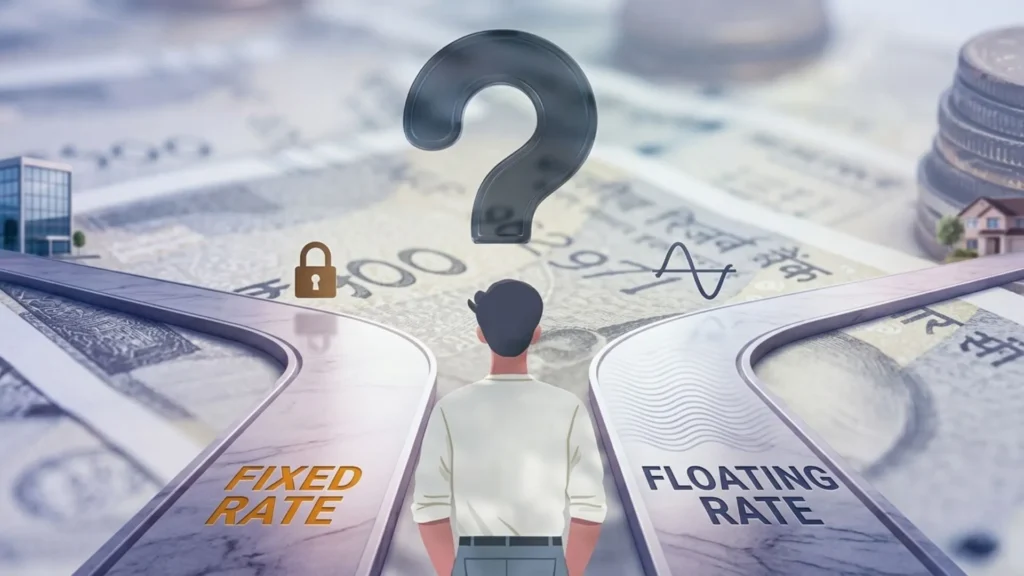
The most important decision in a home loan journey is making a selection between a fixed and a floating rate. It has a direct impact on the total interest outgo, EMI and long-term financial stability. The real difference becomes clear only when you start understanding how each of these interest rates behaves over time, as these lenders present both options. This blog is a guide to the readers and loan takers that offers a clear Fixed vs Floating Interest Rate breakdown. This article will also provide practical insights based on current lending trends and borrower behaviour.
What is a Fixed Interest Rate in Home Loans?
The Fixed Interest Rate is a term used when the interest rate remains consistent for a certain time period, or, in some cases, for the whole tenure, depending on the lender. This also means your EMI stays unchanged apart from market fluctuations.
Key characteristics:
- Stable monthly payments
- Protection from rising interest rates
- Slightly higher initial rate compared to floating options
However, numerous so-called fixed-rate loans in India offer a fixed interest rate for a certain period, only after which they convert to floating. This detail is often missed or overlooked during loan discussions.
What is a Floating Interest Rate?
The floating interest rate keeps changing based on market conditions. In India, these rates are generally linked to the external benchmarks, such as the repo rate set by the RBI.
Key characteristics:
- Rates fluctuate with market movements
- Lower initial interest rate
- EMI or tenure may change over time
This means your loan cost can either increase or decrease depending on economic conditions.
Fixed vs Floating Interest Rate: Core Differences
| Factor | Fixed Rate | Floating Rate |
| EMI Stability | Constant | Variable |
| Initial Interest Rate | Higher | Lower |
| Risk Level | Low | Moderate to High |
| Benefit When Rates Fall | No | Yes |
| Impact of RBI Changes | None immediately | Direct and frequent |
This home loan interest rate comparison shows that the choice depends largely on your risk appetite and financial predictability.
RBI Rate Impact on Home Loans
The floating rates are one of the important factors in the RBI rate impact on home loans. When the Reserve Bank increases the repo rate, the lending rates typically rise and make loans more expensive. The borrower’s benefit through lower EMIs or reduced tenure when the rate is reduced.
For example:
- Repo rate hike → Higher EMI or longer tenure
- Repo rate cut → Lower EMI or faster repayment
Fixed-rate borrowers are generally shielded from these changes, at least during the fixed period. Floating rate borrowers, however, experience these shifts almost immediately.
When Should You Choose a Fixed Interest Rate?
A fixed rate is suitable if your priority is stability and predictability.
Ideal scenarios:
- You prefer consistent monthly budgeting
- Interest rates are expected to rise
- You are risk-averse and want financial certainty
- Your income is stable but not flexible
Fixed rates work well for first-time buyers who want to avoid surprises in their monthly expenses.
When Should You Choose a Floating Interest Rate?
Floating rates are better suited for borrowers who can handle some level of uncertainty.
Ideal scenarios:
- You expect interest rates to fall or remain stable
- You have the capacity to manage fluctuating EMIs
- You plan to prepay the loan early
- You want a lower initial interest burden
Floating rates often prove more cost effective over long tenures, especially when market conditions are favorable.
What Most Borrowers Overlook?
Even after understanding Fixed vs Floating Interest Rate, many buyers miss these practical aspects:
1. Rate Reset Frequency
Floating rates do not change daily. Lenders revise them periodically, which affects how quickly you see changes.
2. Conversion Charges
Switching from fixed to floating or vice versa may involve fees.
3. Loan Tenure Adjustment
Instead of increasing EMI, banks may extend your loan tenure when rates rise.
4. Partial Fixed Loans
Some lenders offer hybrid loans where the rate is fixed for a few years and then becomes floating.
Best Home Loan Rate 2026: What to Expect
When evaluating the best home loan rate 2026, you need to consider broader economic signals rather than just current offers.
Factors influencing rates:
- Inflation trends
- RBI monetary policy decisions
- Banking liquidity
- Global economic conditions
Following recent trends, lenders have now aligned rates with the movements of repo rates. Though floating loans are becoming more transparent, they have become much more sensitive to policy shifts.
In 2026, borrowers can spend less time trying to get the cheapest advertised rates and more time trying to understand how often rates could rise and what events may cause it to.
Practical Decision Framework
Here’s an easy decision frame:
- If rate stability is more important than maximising savings, then get a fixed rate.
- Choose the flexible interest rate if predictability is less prioritised.
You can also divide your loan strategy by prepaying aggressively in the early years if you choose floating rates, reducing exposure to future rate hikes.
Conclusion
In an overall comprehensive view, there is no universal winner in the Fixed vs Floating Interest Rate debate. The right choice always depends on the borrower’s income stability, financial profile and outlook on interest rates.
Fixed Rates offer a peace of mind, if you are a cautious borrower who values certainty. The floating rates can be more rewarding, if you are comfortable with some fluctutions and want to optimise long-term cost.
Understanding how interest rates behave over time an not just what they are at the time of signing, helps in making a well-informed decision.
FAQs
1. Which is better: fixed or floating interest rate for home loans?
It depends on your risk tolerance. Fixed offers stability, while floating offers potential savings over time.
2. How does the RBI repo rate affect home loans?
Changes in repo rate directly impact floating interest rates, influencing EMI or loan tenure.
3. Can I switch from a fixed to a floating interest rate later?
Yes, most lenders allow switching, but it may involve conversion charges.
4. Are floating interest rates always cheaper?
Not always. They start lower but can increase depending on market conditions.
5. What is the best home loan rate in 2026?
The best home loan rate in 2026 depends on the market trends, credit profile and RBI Policies rather than a fixed number.