
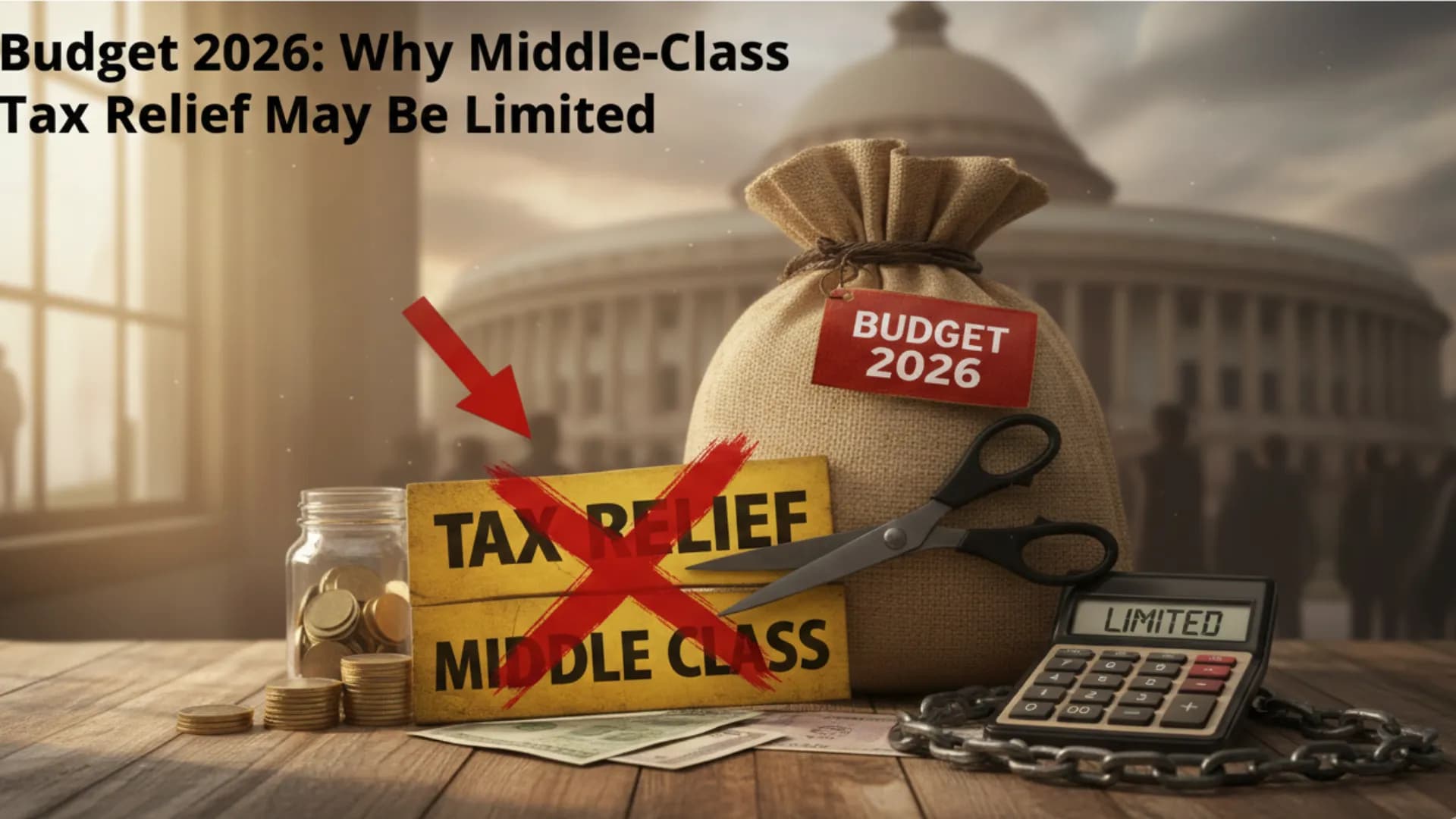
With the approaching union budget 2026 of India, there has been an accruing expectation amongst the tax payers of the country and that of the salaried middle classes. In forums, social media discussions, political financial news news houses, middle-income earners are in the hope that they would have substantial income tax break to soften inflationary pressures and high cost of living. However, amid these expectations, analysts believe that in this economic budget, significant headline tax cuts have minimal chances of materialization. Instead, the government seems eager to aim and narrow down on tweaking of the tax regime, fiscal soundness, long-term structural adjustments, rather than short-run reliefs.
In this overall discussion we unwind the forces that are informing Budget 2026 tax policy, analyse why the broad relief at a wholesale level might not be realised and tell the common taxpayer in the middle-income group what can be realistically expected.
India tax landscape: the current development.
To see the possibility as to why large tax cuts can be not on the table in 2026, it is important to take a look at the development of tax policy over the past years.
The Indian government has just a year ago in Budget 2025 made one of the most profound tax restructuring in decades. In the changed new tax regime, resident taxpayers such as individual income became tax free up to 12 lakh, which in effect trimmed taxes on millions of the middle aged earning group of taxpayers. This reform coupled with increased rebates and wider slabs would have a material positive impact on take-home pay of a large group of taxpayers.
Preceding this, the consecutive budgets had been steadily increasing the exemption level as well as making slab structures simpler, against which the government was determined to make the tax system fairer and less complicated. This tax policy modernization is now considered by the government, as well as the professional community, to be more of a structural adjustment than a short-term sensation-seeking solution.
That scenario can be used to understand why Budget 2026 might not provide additional widespread reduction: the strenuous task of reorganizing taxes has already been performed to a considerable extent.
Fiscal Realities: Limited Headroom for Major Tax Cuts
Although there are hopes among the middle classes that things will get better, the macroeconomics still influence the fiscal policy decisions of the government.
Welfare, Infrastructure, and Defence Snowball Spending.
The expenditure of the government in the areas of infrastructure, defence, welfare, and social safety nets has been increased significantly over the past few years. Examples of public capital spending include an increase of more than two times since FY 2021- increasing by approximately 8 to 11 lakh crore in comparison to 8.4 lakh crores - which indicates the ambitious investment program in India.
Meanwhile, the government has justified Goods and Services Tax (GST) charges on most of the basic things. Although useful to the consumer, this rationalisation decreased by approximately 48,000 crore the GST collection in late 2025 to put additional strain on fiscal income.
Fiscal Consolidation Goals
The fiscal deficit: The difference between the revenue and expenditure is one of the priorities of the policy of India. The deficit has reduced to 5.6% of GDP in FY 2024, having fallen to that level in FY 2021 after a pandemic-driven spike in 2021 reduced it to 9.2. Nonetheless, it is maintaining a balance between the dual goals of the government between stimulating growth and adopting fiscal discipline. The interest payments alone take close to 40 percent of the tax earnings so there is only little space available in large tax cuts without jeopardizing the macroeconomic stability.
Considering these limitations, scholars believe that radical tax reduction would impact on the Indian capacity to invest in the strategic sectors and achieve development objectives in the long run.
Expert Views: Why Relief Is Likely Incremental
One theme in the pre-Budget 2026 commentary of experts is that it is more likely to be incremental changes, as opposed to a broad tax cut.
Tax Reform Already Realized
Dinkar Sharma, Partner at Jotwani Associates observed that personal taxation burdens and compliance arrangements have already been reduced materially as of now in the recent budgets. Considering this situation, the government might also not contemplate additional cuts of the headline rates that would put pressure on the balance of the population.
On the same note, Deepesh Chhedda of Dhruva Advisors stressed that the corporate and individual tax cuts have been considered during the recent budgets. The new individual tax scheme, now at reduced slabs with its rationalized rates has provided a material relief - that is, there may be no need and prudence to make large further concessions.
Attention to Stability as opposed to Surprise.
According to CA Vineet Dwivedi of NPV & Associates, the macroeconomic agendas, e.g. investment-based economic expansion and fiscal containment, can prevail in the current year. With the volatile world situation, which has not yet stabilized due to geopolitical instability and supply chain crises, the policy makers in India are likely to make a miscalculation on the negative side of the story.
All these technical evaluations contribute to the belief that whatever changes implemented to the tax in Budget 2026 will probably be focused and precise and aimed to deal with particular imbalances or areas of pain on the part of the taxpayer instead of a wholesome and indiscriminate relief
What Middle-Class Taxpayers Can Expect
Whereas major reductions might be out of the equation, there are other specific initiatives that would help the middle income group immensely:
Adjacements in Standard Deduction.
The industry associations such as KPMG have also urged to give the standard deduction a raise to 1 lakh and then reduce the standard deduction of 75000 to 1 lakh that would actually increase the tax-free liability to a wide range of earners.
Increase in the standard deduction can have a physical impact particularly to the ₹8-15 lakh range income earner who has a limited disposable income due to inflation, housing charges, and living standards.
Medicalised Thresholds and Operations.
There also are changes that are identified by experts like rationalizing surcharge rates or adjusting slab thresholds. As an example, some of the ways to provide relief to the wider income bands (or to modify the rules of marginal relief) may alleviate the compliance costs and would slightly decrease the tax bill of certain taxpayers.
Other spheres of the existing meaningful relief would also be simplifying tax refunds and accelerating the tax refund process which in many cases take months before individuals can get their tax refund.
Industry-Up-Specific Incentives and Deductions.
Some policy deliberations before Budget 2026 have included permitting some deductions under the new tax regime of interest on a home loan or housing allowances easy access to the new regime would have been harder, traditionally only available with the old regime. Although it is no guarantee, targeted relief would help to lighten the burden on the middle-class homeowners.
Real-World Impacts: What This Means for Taxpayers
To appreciate the practical impact of these trends, consider a typical middle-class household with an annual income of ₹15 lakh. Under the post-2025 tax regime:
- Income up to ₹12 lakh is effectively tax-free thanks to higher rebates.
- The next ₹3 lakh is taxed at moderate marginal rates.
- With a standard deduction of ₹75,000 (or potentially ₹1 lakh), take-home pay improves further.
Even modest improvements — like increasing deduction limits or broadening rebate thresholds — can boost disposable income for such taxpayers, enabling better savings, investment, and consumption choices.
In contrast, no change in tax rates for higher brackets or capital gains taxes means those earning above ₹24–30 lakh may see limited benefit, reinforcing the view that Budget 2026 will prioritize equity and fiscal balance over generous cuts.
Balancing Expectations with Policy Realities
The story before India Union Budget 2026 is a typical policy dilemma: the demands of society to alleviate them against the responsibility of the state to ensure macroeconomic stability. There is an optimistic mood of meaningful, massive tax cuts among Indians of both income brackets, especially with inflation and the cost of living on the increase, but the government seems to be prepared to make gradualist and specific improvements to the tax system instead of sensation-seeking tax breaks.
The policy makers are conscious of the fact that upholding fiscal discipline is crucial in ensuring that economic growth, investment and financing of long term development objectives. Meanwhile, tax reforms of incremental nature might still boost the financial welfare of the middle income population or even shorter than what was expected to be brought by sweeping cuts.
To sum up, the Budget 2026 is expected to become a budget where budgetary steadiness and effective reform are prioritised over some grandiose tax cuts - an indication of the progressing economic maturity in India and the policy change perspectives.
Grow your business through Go Finance- acquire timely, customized business and finance loans that will grow your business. We offer any kind of finance and loan facilities that are easily financed and ensured with sameness.