
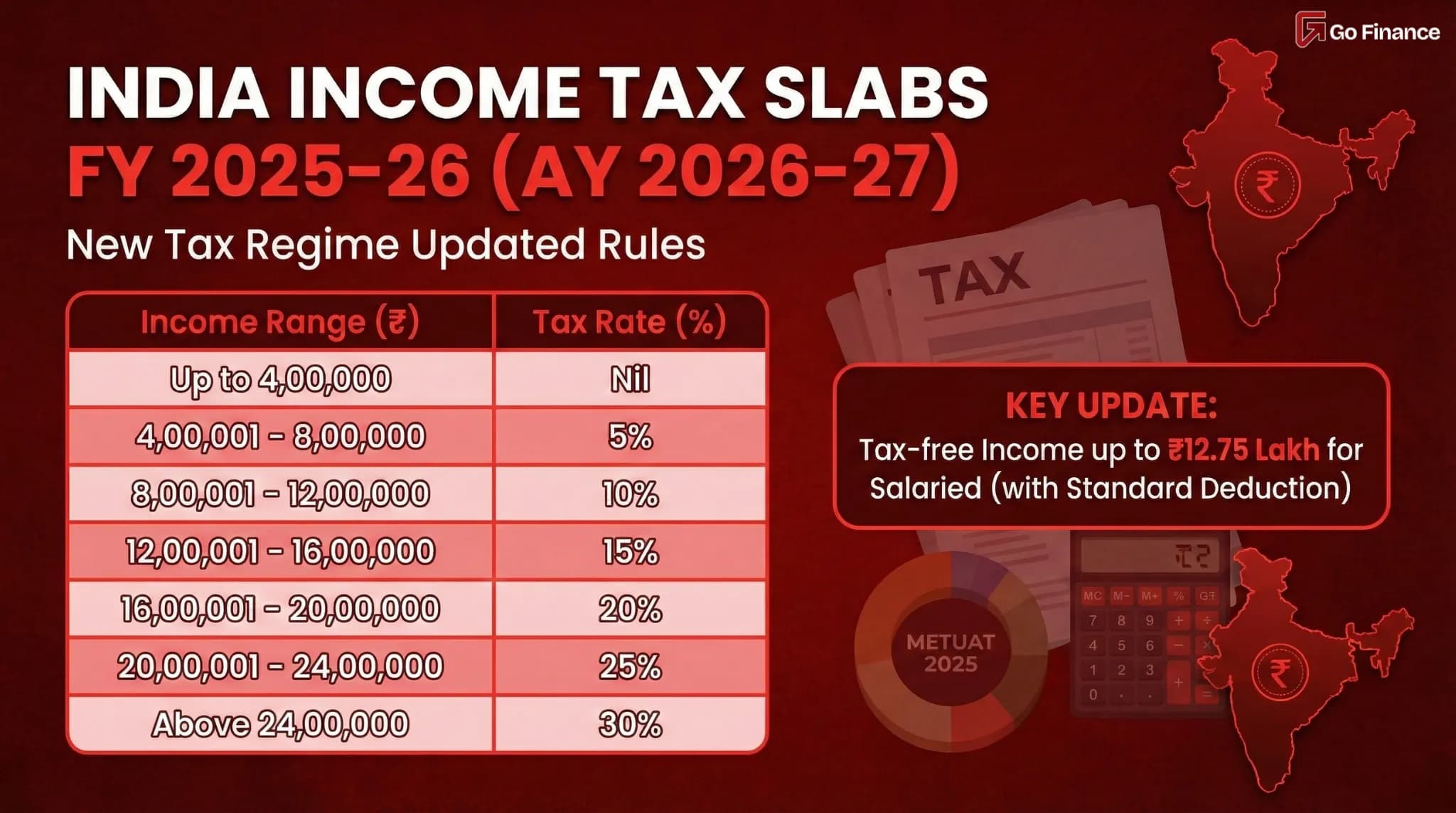
India’s tax landscape is set for a major shift with the upcoming Income-tax Act, 2025, which will shape how both salaried individuals and self-employed professionals manage their finances in the year ahead. As discussions intensify around the Income Tax 2026 India framework, taxpayers are eager to understand what might change, especially when it comes to the new tax slab 2026, deductions, compliance rules, and filing procedures. With digital systems evolving and transparency becoming a policy priority, tax filing in 2026 India could look very different from what we’re used to today. This blog breaks down the key updates, expected reforms, and what these changes may mean for your money in the coming year.
Overview of the Income-tax Act, 2025
The Government carried out this reform to address the complexity of the 1961 Act, which had become a burden due to the various amendments, outdated provisions, and the complex legal language. This complexity led to frequent litigation, a reduced tax base, and administrative difficulties for both the taxpayers and authorities.
Major Goals behind these amendments
The core objectives of the new Act include:
- Simplification: To simplify the number of sections and use plain language to make the law easier to understand and implement.
- Transparency: Eliminating ambiguity, providing clearer definitions, and giving a statutory backing to the digital and faceless assessment procedures to reduce the human interface and potential corruption.
- Ease of Filings: Streamlining the compliance processes, introducing a single “Tax Year” which replaces the previous year and assessment year. Making ITR forms shorter and more pre-filled to reduce the administrative burdens.
New Tax Slab 2026 – What May Change?
| What May Change | What It Means | Quick Example |
| Wider & lower tax slabs | The government may reduce rates and widen ranges to cut taxes. | If a slab drops from 10% to 7%, you pay less on the same income. |
| More relief for middle-income earners | The middle class may get the biggest savings. | Someone earning ₹10 lakh may save a few thousand yearly. |
| Simpler rules for high-income professionals | Fewer exemptions but cleaner, easier filing. | A person earning ₹25 lakh may not get extra deductions, but filing becomes faster. |
What the Changes Mean for Salaried Employees?
| Feature | Old Tax Regime | New Tax Regime | Impact on Salaried Employees |
| Basic Exemption Limit | ₹2.5 lakh (for individuals under 60) | ₹4 lakh | Increased tax-free income threshold under the new regime. |
| Standard Deduction | ₹50,000 | ₹75,000 | A higher flat deduction is available in the new regime without proof of expenses. |
| Tax Rebate (Sec 87A) | Up to ₹12,500 (taxable income up to ₹5 lakh) | Up to ₹60,000 (taxable income up to ₹12 lakh) | Eliminates tax liability for salaried individuals with income up to ₹12.75 lakh under the new regime. |
| Key Deductions/ Exemptions | HRA, LTA, 80C, 80D, and home loan interest (self-occupied property) are generally allowed. | Most common deductions (e.g., 80C, 80D, HRA) are not allowed, except the employer's NPS contribution (80CCD(2)) and interest on a let-out property loan. | Tax planning flexibility is reduced under the new regime, favouring those with fewer investments and deductions. |
| TDS Thresholds | Unchanged | Increased for certain incomes (e.g., interest on bank deposits for senior citizens raised to ₹1 lakh, rent payments to ₹6 lakh annually). | Reduces compliance burden and increases immediate cash flow for recipients of these incomes. |
| Payroll Compliance | Requires employee declaration of intent to opt-out; otherwise, a new regime is applied by default. | Default option for employers' TDS calculations unless the employee provides Form 10-IEA to opt for the old regime. | Employers need systems to manage and process annual employee regime choices. |
What the Changes Mean for Self-Employed & Freelancers?
Under the new expected Income Tax 2026 India changes, which will be applicable from April 2026, the freelancers and the self-salaried individuals might see an ease in tax rules, higher limits in the audit, and clearer presumptive taxation slabs. These modifications will decrease the need for paperwork and help the experts plan their taxes more accurately using the real information.
| Change Area | What You Need to Know |
| Presumptive taxation updates | Income limits may increase (e.g., eligibility up to ₹1 crore), allowing more freelancers to pay tax on a fixed % of income instead of maintaining full books. |
| New compliance norms | More digital records required, fewer manual filings. Expect cleaner invoice tracking and monthly reporting. |
| Books of accounts & audit limits | Audit threshold may rise (e.g., from ₹10 crore to ₹12–15 crore for digital transactions), reducing audit requirements for many professionals. |
| Impact on tax planning | Clearer rules make advance tax estimation easier and reduce the chances of penalties or miscalculation. |
Tax Filing 2026 India: What Will Be Different?
The new Income Tax Act, 2025, beginning from April 1, 2026, will change the tax filing 2026 considerably in India. This change is to make the system easier and more digitally compliant for the taxpayers.
The major differences in the tax filing for 2026 India involve:
- New Filing System and Portals: This is the replacement of the current, complicated Income Tax Act of 1961 with a modern, less section law, with simpler language. It has streamlined ITR forms that are in the process of being designed and will also be notified by January 2026 to allow taxpayers and software providers time to change their systems.
- Improved Pre-filled ITRs and AI Checking: The new forms will contain significantly more pre-filled information with sources such as AIS, TIS, and GST returns, which will minimize manual data entry and errors. The department is using AI-aided verification and data matching to enhance the accuracy and compliance.
- Quicker Refund Processes: It is anticipated that procedures related to legitimate refunds will be quicker due to enhanced accuracy caused by improved data matching. The delay that is currently experienced on some high-value refunds is due to discrepancies and manual verification that will be reduced in the new system. Other proposals are the provision of a real-time refund tracking dashboard on the e-filing portal to ensure more transparency.
The proposed new system will be easier to use, more transparent, and more digitally advanced, which will eventually reduce the load on the regular taxpayers.
How to Prepare for the 2026 Tax Changes?
Making yourself ready for the new tax slab 2026 changes, including the new default tax regime in India and the potential US tax law expirations, it is important for having maximize savings. The proactive planning makes sure that you can adapt to the new income tax, update Indian regulations, and make use of the available opportunities effectively and efficiently.
- Review Income Structure: To assess the current income sources will become important to understand how they align with the new tax slabs 2026 and rules, especially in situations where there will be a choice for a new and old tax regime in India.
- Track Deductions: Keep a close watch on all the potential expenses and investments that can easily qualify for deductions under either tax regime, as the availability of the deductions is a key differentiator.
- Maintain Digital Record: Keep all the financial documentation organised and in a digital format for easy access and accurate reporting, which is important for compliance with the modern e-filing processes.
- Make Use of professional advice or tax tools: Before filing for tax returns, it is advisable to consult a tax advisor or make use of the reliable tax software to help navigate the complexities, confirm the best tax strategy for your specific circumstances, and make sure all the filings are accurate and on time.
Conclusion
With the changes made in the Income Tax Act, 2025, which will be applied from April 2026, it will become easy for the salaried, self-employed, and freelancers to file their ITR on time and maximise their savings without having the need to have paperwork.