
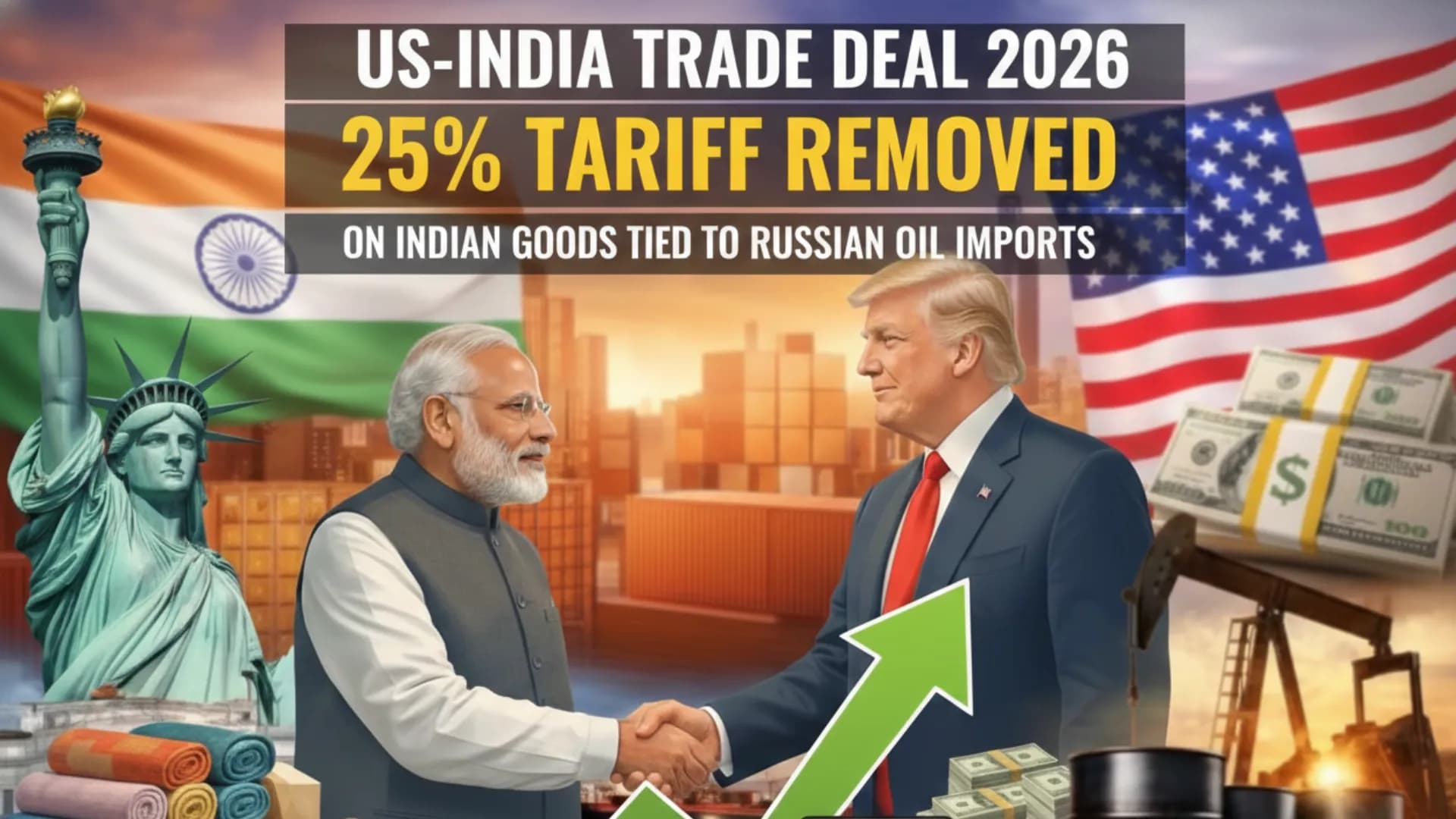
A Complete Evaluation of the Trade Policy, Economic Consequences, and Strategy Change (2026 Update).
The United States has abolished a punitive tariff of 25 percent on Indian manufactured items, a move that is directly linked to the pledge of the Indian government to stop buying Russian oil. This major turnaround indicates the broader India-US trade deal, which is supposed to calm down the recent tensions, open up business horizons and recalibrate the economic collaboration between the two largest economic blocs in the world.
The origin of the conflict: Tariffs and Russian Oil.
In August 2025, a 25% ad valorem tariff was imposed on Indian imports into the United States, with a further penalty of 50% tariff on most items arising as a result of the extra tariff penalty imposed on continued imports of Russian crude oil.
The U.S. administration at the time cited national security measures (especially the International Emergency Economic Powers Act and other regulations) in defense of punitive tariffs, which, it said, India had weakly subsidized Russia’s war effort, as it bought its oil by proxy, a fact that attracted fierce denunciation by New Delhi. India countered this by underlining its energy security requirements, a fact that it imports approximately 80 percent of its crude demands and that Russian crude provided it with supply diversification and competitive prices.
Economists cautioned that the tariffs might have an extremely dire impact on the Indian exports involving textiles and leather to gem and jewellery by diminishing its competitiveness and market share in the US. The threat of unemployment and the effect on the GDP was taken seriously.
The 2026 Turnaround: Trade Deal and Tariff Removal
In early February 2026, U.S. President Donald Trump signed an executive order rescinding the additional 25% tariff, contingent on India’s promise to stop directly or indirectly importing Russian oil.
The terms of the agreement — part of a broader interim trade framework — include:
- Termination of the punitive 25% tariff, effective February 7, 2026.
- A reciprocal reduction of other tariffs, bringing them down to 18% from previous levels (some had been effectively 50%).
- Elimination of tariffs on certain U.S. imports such as aircraft and aircraft parts under the same framework.
- A commitment by India to import approximately $500 billion in U.S. goods over five years, spanning energy products, technology, metals, and more.
- A framework to expand defence cooperation over the next decade.
This reversal signals not merely a policy tweak but a strategic realignment, suggesting both countries see value in deeper economic integration rather than continuing a high-stakes tariff confrontation.
Economic and Market Impact
Relief for Indian Exporters
It is believed that the tariff rollback will rekindle competitiveness in exports of Indian companies to the U.S market that is one of the largest trading partners of India. The diminution of duties to 18 removes market access impediments greatly and Indian manufacturers will be able to recover pricing power against their regional rivals.
Industries that faced the threat like textiles, apparel, leather goods and machinery due to the prohibitive tariff rates may experience new order flows as well as increased capacity utilization. Market analysts believe that by reducing tariffs, part of these sectors would no longer be in a survival mode; they are in the growth mode as economics is not in punitive cost structures but strategic prices.
Supply Chains and Price Sensitivity.
To the U. S. consumers, abolished punitive duties may translate to reduced prices on imported products that used to command high prices because of high tariff rates. This can help ease inflationary pressures on products which constitute global manufacturing inputs, including textiles and electronics parts.
Simultaneously, Indian oil and refinery-related companies will change the supply chains, which might make exports of U.S. or other allies to rise, which is also echoed in energy supply chains.
Broader Trade Flows
With India’s commitment to purchase U.S. energy products, precious metals, and tech goods, the trade pact could reshape long-term flows. Indian demand for U.S. energy — even as it diversifies suppliers — strengthens economic ties while broadening America’s export base.
Geopolitical Dimensions
India’s Strategic Autonomy
The balancing between Russia and the West has made a long history in India serving as one of its foreign policy pillars based on strategic independence. Its energy association with Russia has given it stability of prices and security of supply. The first tariffs that Washington introduced fought that equilibrium leading to diplomatic tension.
India is walking on a thin needle by accepting to stop importing Russian oil. This step is also a distinctive indicator of conformity to U.S. geopolitical ambitions but has repercussions on its conventional alliances and its general non-aligned stance.
Enhanced India U.S. Relations.
The tariff rollback highlights a new level of collaboration between the Prime Minister Narendra Modi administration and the U.S administration that might lead to a more detailed Bilateral Trade Agreement (BTA). The increased defence cooperation and trade engagements show the strengthening of the strategic partnership.
The interim trade agreement was characterised by External Affairs Minister S. Jaishankar was opening new horizons of cooperation, suggesting that New Delhi views economic benefits and geopolitical orientation.
Risks and Future Challenges
Despite positive immediate impacts, several questions remain:
- Monitoring compliance: The U.S. reserves the right to reimpose tariffs if India resumes Russian oil imports, introducing a compliance and verification challenge.
- Domestic industrial impact: Rapid expansion of U.S. imports into India could challenge local manufacturers unless protective and adaptive policies are simultaneously pursued.
- Global energy market volatility: Shifting away from Russian crude may expose India to higher energy price volatility unless alternative sources are secured cost-effectively.
These factors will shape the long-term viability of the trade framework.
Conclusion: A Strategic Trade Reset
It is not just a story of tariffs when the 25% tariff on Indian goods replacing Russian oil purchases is taken away. It is the reset of trade policy, geopolitical recalibration and utilitarian re-calculation of global economic priorities. This development presents a way forward to both the countries as far as revived export opportunities are concerned, as well as enhanced bilateral cooperation although with a cautious consideration of national interests.
With the future of global trade dynamics changing in 2026 and beyond and this episode, it underscores the significance of flexible diplomacy, market-based changes in policy, and strategic alliances in going through a more and more interconnected economic order.
Boost your business with Go Finance- get quick and convenient finance and business lending tailor made to your expansion. We offer every kind of finance and loan facilities at an easy approval and with stable support.