
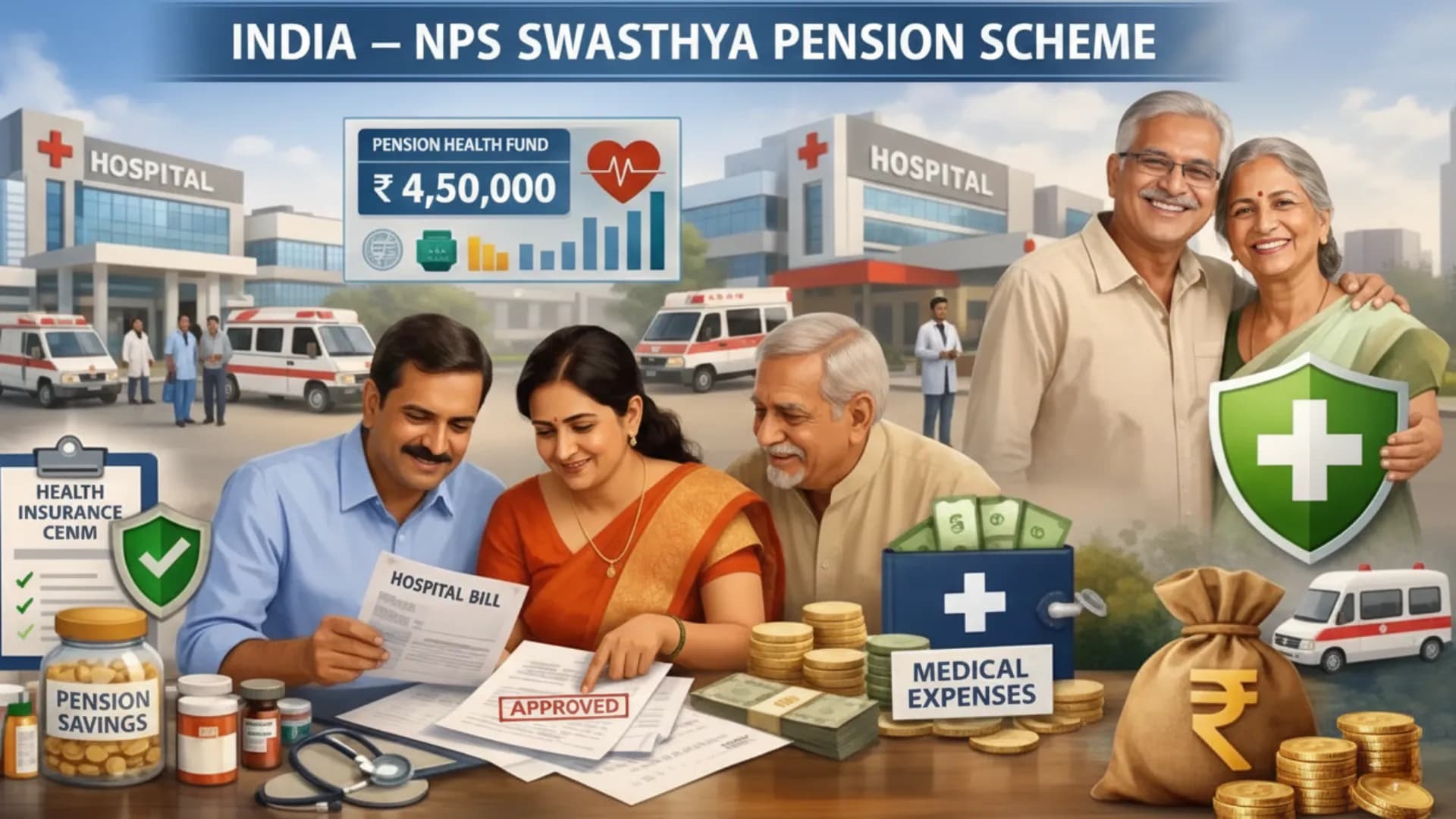
- 1.The NPS Swasthya Pension Scheme.
- 2.Who Can Join the NPS Swasthya Pension Scheme?
- 3.Strategic Contribution and Investment Model.
- 4.Charges and Cost Transparency
- 5.Explained: Medical Coverage and Claim Rules.
- 6.Why the NPS Swasthya Pension Scheme Matters Today
- 7.Comparison with Traditional Pension and Health Insurance Models
- 8.Tax Benefits and Regulatory Oversight
- 9.Practical: A Real-Life Use of the Scheme.
- 10.Strategic Role in Modern Financial Planning
The retirement environment in India is experiencing structural change due to multiplies of longevity, rise in cost of healthcare and loss of traditional pension safety nets. To cope with this dynamic problem, the Government of India has proposed NPS Swasthya Pension Scheme, healthcare based pension scheme within the National Pension System (NPS). The idea of the scheme is to combine retirement income protection and medical expense protection and later, this type of combination is becoming more and more necessary in the financial planning scenario.
Introduced in 2025 and covered by The Financial Express, the NPS Swasthya Pension Scheme is one example of a wider policy change to integrate all post-retirement welfare to think holistically about the integration of pension planning and healthcare affordability and insurance coverage.
In an in-depth, well-researched analysis of the scheme, including the eligibility, the contribution structure, the charges, the medical claim rules, the benefits, and their applicability under the current financial planning scenarios, this paper will discuss the scheme.
The NPS Swasthya Pension Scheme.
The NPS Swasthya Pension Scheme is a continuation of the prevailing National Pension System which aims at providing its subscribers with dual benefits based on pension plans which include provision of regular pension at retirement age as well as providing systematized coverage of healthcare costs in old age.
Contrary to the conventional pension schemes that only pay attention to income replacement means, this scheme acknowledges healthcare as one of the greatest retirement hazards of the retirees. The industry estimates healthcare inflation has been at an average of 12-14% per annum, which is rather well ahead of overall inflation. Because of this even those retirees who are well-financed tend to be stressed with medical expenses.
The NPS Swasthya Pension Scheme will mitigate this vulnerability by combining pension accumulation and health protection.
Who Can Join the NPS Swasthya Pension Scheme?
The scheme has eligibility criteria that are consciously large in order to promote participation in the scheme by all income and employment brackets.
The scheme applies to Indian citizens between the age of 18 to 70 years, and includes the salarried employees, the self employed individuals, the professional workers and the workers in informal sector as well. Current NPS subscribers may also go to the Swasthya option, on agreed terms.
This non-discriminatory idea is especially significant in India where more than 85 percent of people work in the unorganized sector and do not have their healthcare or retirement benefits covered by their employer.
Strategic Contribution and Investment Model.
The NPS Swasthya Pension Scheme uses the defined contribution structure in its contributions. Regular contributions by the subscribers are made during their working days, which are invested in a combination of equity, corporate bonds and government securities according to the selected asset allocation scheme.
Part of the accrued corpus is used to cover medical coverage and health benefits whereas the rest is used to fund the retirement pension fund.
Key Features of Contributions
| Aspect | Details |
| Minimum Entry Age | 18 years |
| Maximum Entry Age | 70 years |
| Contribution Flexibility | Voluntary, based on subscriber capacity |
| Investment Options | Active or Auto Choice |
| Pension Payout | Post-retirement annuity |
| Healthcare Component | Integrated with pension corpus |
This structure ensures that contributors benefit from market-linked returns, while also building a buffer for healthcare expenses.
Charges and Cost Transparency
The NPS ecosystem has one of the most characteristic features in a low-cost structure, and the Swasthya Pension Scheme is no exception.
Fee costs are fund management charges, account management charges, and low costs of administration charges. All these are much cheaper than the cost of a private pension scheme or single health insurance.
The reduced costs are translated to increased net returns in the long-term which is imperative in retirement planning.
Explained: Medical Coverage and Claim Rules.
The NPS Swasthya Pension Scheme will take into account the healthcare part of the scheme to cover hospitalization, critical illnesses and medical requirements of an age.
Although this scheme is not a classic indemnity health insurance plan the scheme offers programmed medical assistance with established claim processes.
Key Medical Claim Features
| Feature | Description |
| Coverage Type | Medical expense support post-retirement |
| Eligible Expenses | Hospitalization, major treatments, approved procedures |
| Claim Process | Defined claim submission framework |
| Funding Source | Allocated portion of pension corpus |
| Flexibility | Subject to scheme-specific medical rules |
The integration of medical support within the pension framework reduces dependence on external health insurance policies, especially in advanced age when premiums typically surge.
Why the NPS Swasthya Pension Scheme Matters Today
We can see the applicability of this scheme with reference to the demographic and economic trends in India.
The population aged (60 and above) in India is already estimated to be 319 million in 2050, almost two times as much as at present. Medical expenses, meanwhile, are growing faster than work incomes and employer-sponsored pensions are currently plunging downward.
The conventional forms of planning retirement traditionally tend to understate the amount of healthcare bill and thus the corpus becomes depleted in less than ten years of retirement. The NPS Swasthya Pension Scheme fills this gap by incorporating healthcare planning into the retirement savings.
Comparison with Traditional Pension and Health Insurance Models
| Criteria | Traditional Pension | Health Insurance | NPS Swasthya Pension |
| Pension Income | Yes | No | Yes |
| Healthcare Support | No | Yes | Yes |
| Cost Efficiency | Moderate | High premiums in old age | Low-cost |
| Market-Linked Growth | Limited | Not applicable | Yes |
| Long-Term Sustainability | Medium | Low after 60 | High |
This comparison highlights how the scheme offers a more balanced and sustainable retirement solution.
Tax Benefits and Regulatory Oversight
Additional funds to the NPS Swasthya Pension Scheme attract tax benefits as in Section 80C and 80CCD like with the existing NPS rules. This raises its appeal as far as tax-effective retirement planning is concerned.
The Pension Fund Regulatory and Development Authority (PFRDA) regulates the scheme so as there is transparency, governance and protection of the investors.
Practical: A Real-Life Use of the Scheme.
Take a working self employed individual of 35 years who pays 6000 a month to NPS Swasthya Pension Scheme. On the horizon of 25 30 years, with average returns in the markets, the person accumulates a considerable amount of retirement corpus.
A certain amount of this corpus is used at retirement to generate a fixed monthly pension and Swasthya, which is used to cover the cost of hospitalization and treatment that would otherwise be taking away savings. The latter has a strong financial stand resilience to retirement.
Strategic Role in Modern Financial Planning
Financially, the NPS Swasthya Pension Scheme is appropriate in a stratified retiring plan, which could have mutual funds, term insurance and emergency savings.
It is especially useful with those people who lack employer-sponsored retirement plans, as well as health insurance after retirement.
Conclusions: One Step to Integrated Retirement Security.
NPS Swasthya Pension Scheme is a turning point in the development of the Indian pension system since the idea of retirement safety cannot be full without healthcare insurance.
The scheme will provide both practical and cost-efficient and future-ready solution to the aging population in India since the pension money will be used in combination with systematic support on medical care. This initiative is worth consideration among long-term investors who need to be stable, tax efficient, and have a holistic retirement planning approach.
Grow your business through Go Finance– take quick, custom-built finance and business loans that will grow your business. Easy approval and secure support of all forms of finance and loans.