
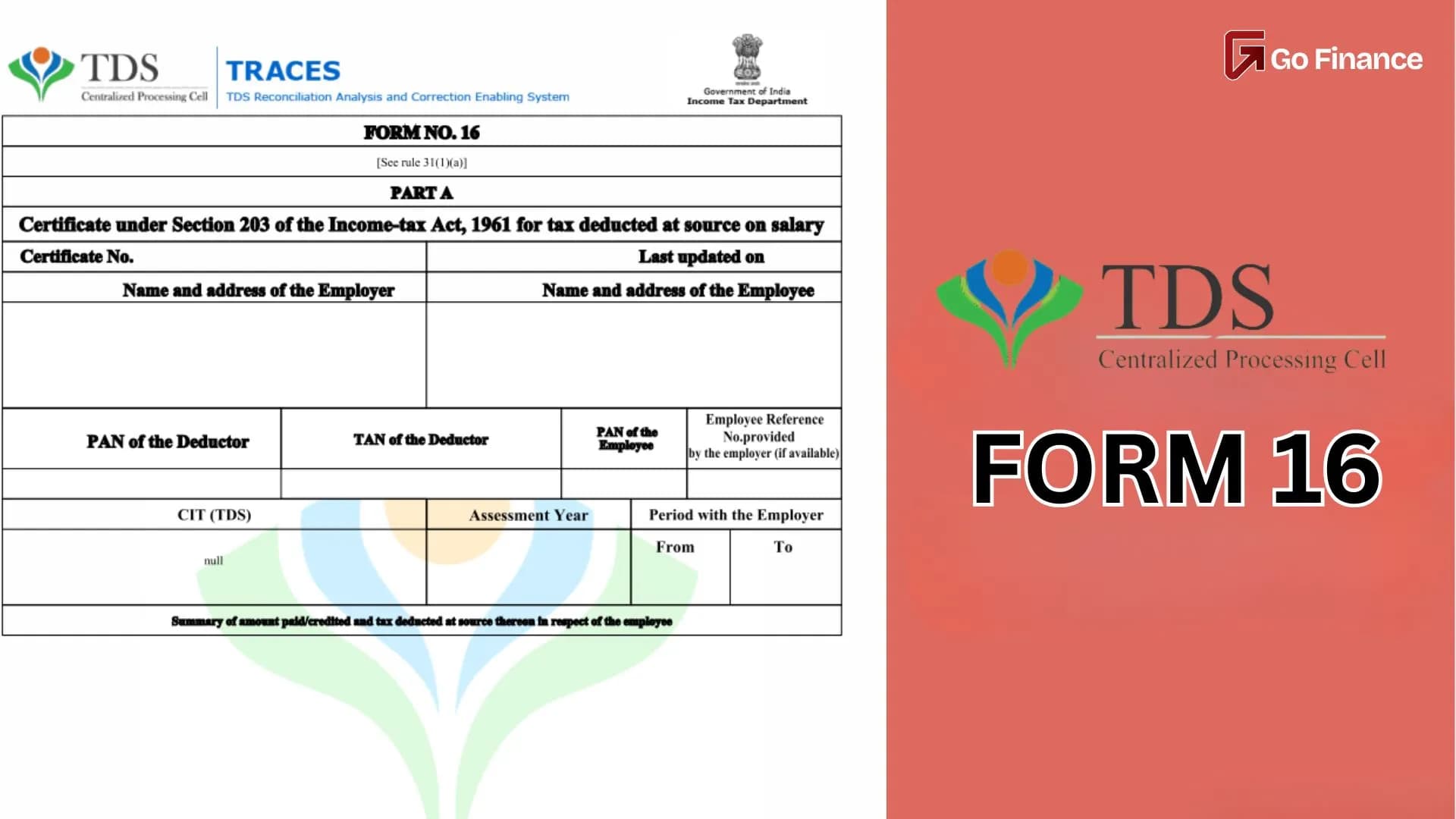
Ever looked at your salary slip and given a thought about where your taxed money actually goes, and why every time in June, your HR becomes the most important person in your life? Here is where Form 16 comes in, the ultimate document that decides whether your ITR filing feels like a smooth ride or a mini heart attack. Income Tax Form 16 is like the report card of your financial year, which shows how much you have earned in a year, how much tax has been deducted and whether you have been a responsible taxpayer. If you have ever felt confused during the tax season, this one form will simplify everything. In this blog, we will be breaking down Income Tax Form 16 in the simplest, smartest way, so you can finally understand where your money went, why this document matters and how it can also save your time, stress and tax troubles.
What is Form 16?
Income Tax Form 16 is a certificate that is given by the employer to the employee in the month of June and then submitted to the Income Tax Department. The details how much tax the employer has deducted and when it was submitted to the IT department.
In case there is an individual who has switched jobs during a particular year, or worked with different employers at the same time, and tax has been deducted at all places, you must obtain a separate Income Tax Form 16 from each one of them. However, if your employer did not deduct any tax at source from your salary, considerations your income for the year is below the tax-exemption limit, they may not issue Form 16.
Why is Form 16 Important?
Income Tax Form 16 is important because it is a mandatory document for salaried individuals in India, which serves primarily as proof of income and the Tax Deducted at Source (TDS) by the employer. Its importance extends to several key financial and legal functions.
Some of the key reasons why Form 16 is important are as below:
- It helps in facilitating Income Tax Returns (ITR) Filing. Form 16 helps in easing the process of filing for ITR as it is an important document which contains a comprehensive, standardised summary of your entire financial year’s salary, allowances, deductions and the exact amount of tax already paid to the government.
- Form 16 is also used as proof of Income and Tax compliance. It is an official certification that states your employer has deducted the correct amount of tax from your salary and deposited it with the Income Tax Department on your behalf.
- It is important for loan applications, as all the financial institutions in the world first inquire about the Form 16 before approving home loans or personal loans. This Income Tax Form 16 is a reliable indicator of your financial stability and repayment capacity. It helps credibility and can also help secure better interest rates.
- It helps in Financial planning and verification, as it gives you a proper breakdown of your finances, deductions and other components under the various sections and exemptions claimed.
- As a salaried individual, too, when you apply for an international trip, you will be required to provide Form 16 for the visa approval process as proof to show that you have a stable income and tax compliance in your home country.
- When we see it from a legal point of view, every employer must issue a Form 16 to their employees under the Income Tax Act. It is a statement that shows the employees' details about the TDS cut from their salary annually. If the employer is not successful in issuing the Form 16, then they can be penalised.
Structure of Form 16
The Form 16 consists of the information that you need to prepare and file your income tax return. However, this form itself also has two main components- Part A and Part B, which also reflect that of your details bifurcated into parts. Both of these parts are very important when filing for IT returns. Here is a look at the components of Form 16 in detail:
What is Form 16A
Form 16A consists of the most basic details of the employees and their employers, such as:
- Name of the employee
- Address of the employee
- PAN Details of the employee
- Name of the employer (tax deductor)
- Address of the employer (tax deductor)
- PAN of the employer
- Address of the employer
It also contains the details of how much tax was deducted, the dates when the amount was deposited into the Central Government Account and the details of the challan issued by the government.
What is Form 16B
Form 16B contains a detailed breakdown of how your tax was computed, considering the investment declaration you made at the beginning of the financial year and the proof of the investment that was submitted afterwards. It also includes the details of the other allowances that your employer provided to you.
It contains the following information:
- Your Gross Salary
- Allowances exempt u/s 10
- Tax on employment
- Deductions u/s 80C, which also includes details like Provident Fund (EPF/PPF), Housing Loan, National Saving Certificate, Life Insurance Plans, Tax Saving Mutual Funds (ELSS) and any other investment in tax saving schemes.
- Tax on Total Income
- Deductions under Other sections (80E, 80G, 80TTA), which include National Pension Scheme, medical claims, donations exempt u/s 80-G and others.
- Tax on Total Income
- Any cess levied (e.g. Education cess, Swachh Bharat cess, levied by the Government from time to time)
- Any rebate on Tax
- Any surcharges
Eligibility: Who gets Form 16
Form 16 is a Tax Deducted at Source (TDS) certificate that is issued by an employer to a salaried employee in India. The primary eligibility criterion is whether the employer has deducted tax from the employee’s salary during the financial year.
- The employees with TDS deducted.
- The employees whose Income exceeds the basic exemption limit.
- The employees who switch jobs
- Pensioners
The Form 16 may not be issued when the employee's income is below the taxable limit.
Difference between Form 16, Form 16A and Form 16B
| Features | Form 16 | Form 16A | Form 16B |
| Type of Document | TDS certificate for salaried income | TDS certificate for non-salary income | TDS certificate for property transactions |
| Covers | Salary, allowances, deductions, taxable income, and TDS are deducted by the employer. | TDS on interest, professional fees, rent, commission, or any non-salary payment | TDS is deducted by the buyer when purchasing a property worth ₹50 lakh or more |
| Issued By | Employer | Banks, companies, or any entity deducting TDS on non-salary payments | Property buyer |
| Issued To | Salaried employee | Individuals receiving non-salary income | Property seller |
| Purpose | Used during ITR filing and as income proof | Used to match TDS on non-salary income while filing ITR | Used to confirm the TDS deposit during a property sale |
| Frequency | Issued annually | Issued quarterly | Issued per property transaction |
| When You Need It | For filing ITR and verifying salary-related tax deductions | For filing ITR if you have interest income, freelance income, rent, etc. | Needed in property purchase documentation to prove TDS compliance |
Common Mistakes to Avoid in Form 16
| Name of the Mistake | Mistake Made | Solution |
| Incorrect Personal Details | Small errors in your name, PAN, or address can slow down processing and even affect your tax refund. | Double-check that all your details in Form 16 match exactly with your PAN and Aadhaar records. |
| Mismatch in TDS/Income Details | The TDS shown in Form 16 doesn’t match what appears in Form 26AS or AIS, leading to confusion or errors in your return. | Download Form 26AS and AIS from the IT portal and compare them with Form 16. If something doesn’t match, ask your employer to correct it by revising the TDS return. |
| Not Reporting All Income Sources | Many people only consider their salary from Form 16 and forget interest income, rent, capital gains, etc., which can lead to notices later. | Collect all income proofs—bank statements, FD interest, rent receipts, investment reports—and include everything while filing your ITR. |
| Missing Eligible Deductions | You may overlook deductions under 80C, 80D, 80G and others, which means paying more tax than necessary. | Keep receipts of all investments, insurance premiums, donations, etc. Ensure they are added correctly in Form 16 or claim them manually during ITR filing. |
| Choosing the Wrong ITR Form | Using an incorrect ITR form (like ITR-1 when you have capital gains or multiple properties) can make your entire return invalid. | Pick the right ITR form based on all your income sources and your category of taxpayer. |
| Not Verifying Your ITR | Filing is not enough—if you forget to e-verify within 30 days, your return is treated as not filed at all. | E-verify instantly after filing using Aadhaar OTP, net banking, or any other option on the IT portal. |
| Filing After the Due Date | Missing the deadline may lead to late fees and interest on pending taxes. | Keep track of the due date and get your documents ready in advance to avoid last-minute stress. |
Conclusion
Form 16 is a very important piece of paper for both the employee and the employer, as it has different importance for different people. As an employer, they are legally bound by the Income Tax Act to provide the employees with a salary above the exemption level with Form 16. This helps the employees know the proper details about the tax deducted from their salary and the dates when it was submitted to the Central Government. So if you are someone who has recently received the Form 16, then you can refer to this blog and know more about it.
aman03yadav1999@gmail.com