
The Strait of Hormuz crisis is also one of the most monitored geopolitical issues in 2026. The increasing tensions in the Middle East made them fear world oil shipments may be terminated and this will lead to energy shortages and oil price shock in the entire world. Nonetheless, one major diplomatic development happened when Iran was quoted to have allowed vessels belonging to India safely to transit the highly strategic Strait of Hormuz even with the prevailing conflict.
It is much more than another sea news item. It is a great strategic advantage to India, a stabilizer to the world oil markets and an eye opener on how diplomacy could secure economic interests in case of a geopolitical crisis.
In this blog we disaggregate the reasons as to why the Strait of Hormuz crisis is important, the advantages to India, and to the rest of global trade, shipping, and financier markets.
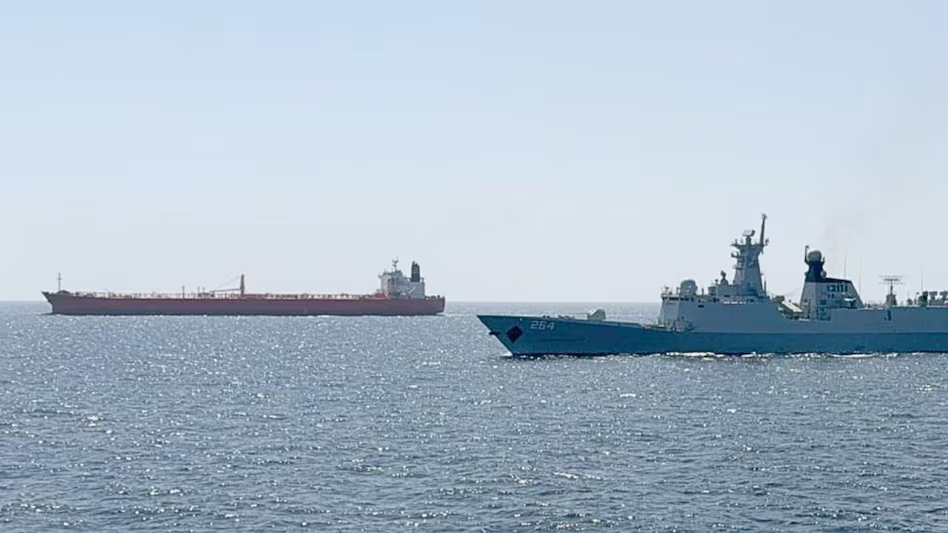
The Strait of Hormuz Crisis Why It Is Important to the World.
The Strait of Hormuz is the most sensitive sea route of shipping oil on the planet. It links the Persian Gulf with the Arabian Sea and allows export of energy of some of the largest oil producers in the world.
Key Global Energy Statistics
| Factor | Impact |
| Global oil transported | ~20% of global oil supply |
| LNG shipments | ~30% of global LNG trade |
| Countries dependent on route | India, China, Japan, South Korea, Europe |
| Average daily oil flow | ~20 million barrels |
Because such a massive portion of global energy passes through this narrow channel, any Strait of Hormuz crisis immediately affects fuel prices, inflation, and stock markets worldwide.
For India, the stakes are even higher.
Why the Strait of Hormuz Crisis Is Critical for India
India is the world’s third-largest oil importer and relies heavily on crude oil shipped through the Gulf region.
India’s Energy Dependence
| Energy Factor | Percentage |
| Oil imported by India | ~85% of total demand |
| Oil passing via Strait of Hormuz | ~40% of imports |
| Indian seafarers in Gulf waters | ~23,000 |
During the Strait of Hormuz crisis, any disruption could have triggered:
- Rising petrol and diesel prices
- Inflation in transportation and manufacturing
- Increased import bills
- Pressure on the Indian rupee
Therefore, Iran allowing Indian vessels safe passage is a massive strategic relief for India’s economy.
Major Benefits of Iran Allowing Indian Ships Through the Strait
The decision has multiple advantages across energy security, trade stability, and geopolitics.
1. Protection of India’s Energy Supply
The most immediate benefit of the Strait of Hormuz crisis easing for Indian ships is stable oil supply.
Indian refineries rely on crude shipments from Gulf nations including:
- Saudi Arabia
- Iraq
- UAE
- Kuwait
Without access through the Strait of Hormuz, India would have been forced to seek longer and more expensive shipping routes, increasing fuel costs nationwide.
Safe passage ensures:
- Continuous crude supply
- Stable refinery operations
- Reduced risk of fuel shortages
2. Preventing Oil Price Shock in India
The crisis in Strait of Hormuz first made people fear that the oil prices could rise up to above 150 per barrel in case the route was passed.
Disruption threat of supply has been minimized, helping by letting Indian ships through, thereby:
- Stabilize oil prices
- Prevent inflation spikes
- Guard prices of fuel to protect consumers.
This is very crucial to a big developing economy, such as India.
3. Enhancing the Indian Iranian Diplomatic Relationship.
Such action is an indication of the long historical strategic partnership concerning India and Iran.
Historically India has been cooperating with Iran on issues like:
- Energy trade
- Infrastructure projects
- Maritime cooperation
- Regional connectivity
The fact that the Strait of Hormuz crisis was solved by letting the Indian ships pass through proves that even in the conditions of the conflict, diplomatic communication could work.
4. Protection of Indian Seafarers
Thousands of Indian sailors work on commercial vessels in the Gulf region.
During the peak of the Strait of Hormuz crisis, many ships were stranded or at risk of attack. Ensuring safe transit protects:
- Indian seafarers’ lives
- Maritime workers’ livelihoods
- Shipping industry stability
For India, this is not just an economic issue but also a human safety priority.
5. Stabilizing Global Shipping Routes
The global shipping industry depends heavily on predictable and secure routes.
During the Strait of Hormuz crisis, shipping companies faced:
- Increased insurance costs
- Security threats
- Vessel rerouting
Allowing Indian ships to pass helps maintain trade flow and reduce panic in maritime markets.
This indirectly benefits:
- Oil traders
- Commodity markets
- Global logistics companies
Economic Impact of the Strait of Hormuz Crisis
The Strait of Hormuz crisis has major implications for financial markets.
Potential Economic Effects
| Sector | Impact |
| Oil markets | Price volatility |
| Stock markets | Energy stocks surge |
| Shipping industry | Higher insurance premiums |
| Inflation | Fuel price increases |
| Global trade | Supply chain disruption |
Even minor disruptions in the strait can influence global economic stability.
Strategic Lessons for India from the Strait of Hormuz Crisis
This crisis also highlights why India is rapidly diversifying its energy strategy.
India’s Long-Term Energy Strategy
India is investing in several measures to reduce future risks from a Strait of Hormuz crisis:
1. Strategic Petroleum Reserves
Emergency crude storage facilities to handle supply disruptions.
2. Diversified Oil Imports
Increasing purchases from:
- Russia
- United States
- Latin America
3. Renewable Energy Expansion
India is rapidly expanding solar and green hydrogen projects.
4. Maritime Security Monitoring
Indian authorities closely track shipping routes and naval security.
These strategies help India reduce vulnerability to geopolitical tensions.
Real-World Example: Oil Tanker Reaching India
The significance of this choice could be explained by one of the examples, because, despite being caught in the middle of the crisis, a Saudi crude oil tanker was able to reach Mumbai by passing through the Strait of Hormuz.
This one conquest was another of the messages:
- The energy supply lines are not destroyed.
- The diplomatic lines are operating.
- Oil markets panic can be decreased.
Limited victorious shipments can go a long way in slacking worldwide markets in times of a Strait of Hormuz eventuality.
What To Expect in case the Strait of Hormuz Crisis Worsens?
Experts have sounded an alarm by saying that a further escalation of tensions will have ramifications.
- More than 200 barrel oil prices.
- Global recession risks
- Massive transportation accidents.
- Asian shortages of energy and Europe.
This is the reason why there is such a crucial concern to diplomatic stability in the region.
The last thing: The importance of this Development.
The Strait of Hormuz crisis is not merely a world of the story of regional conflicts but this is a world-wide economic story of energy markets, passenger routes, and financial stability.
There are critical benefits to Indian ships that will be received by Iran to permit them to safely pass through the Strait of Hormuz and they include:
- Obtaining Indian energy supply.
- Regularizing the oil markets across the world.
- Saving thousands of Indian mariners.
- This preservation of sea routes.
- Enhancing diplomatic activity.
This move is a significant geopolitical and economic triumph in a stressful situation across the world, as far as India is concerned. The world will follow with keen interest the events in the Strait of Hormuz even more as the crisis remains unresolved.
Be ahead of international financial developments and market trends – make smarter financial choices with GoFinance now.