
The increasing geopolitical situation between the United States and Iran as well as Israel has caused tremendous disturbances in the energy markets around the globe. One of the most immediate consequences has been a sudden LPG supply disruption in India, raising concerns among households, restaurants, and industries dependent on cooking gas. Although most of the people had anticipated that petrol and diesel prices would go sky-high initially, the truth came out in a different way LPG became the first fuel to be hit.
To comprehend the initial problem of the supply of LPG it will be necessary to have a further examination of the global shipping pathways, the situation of India relying on imports, and the strategic significance of the Strait of Hormuz energy crisis. This article explains the economic, logistical, and geopolitical reasons behind the LPG supply disruption in India, and what it means for the country’s energy security and economy.
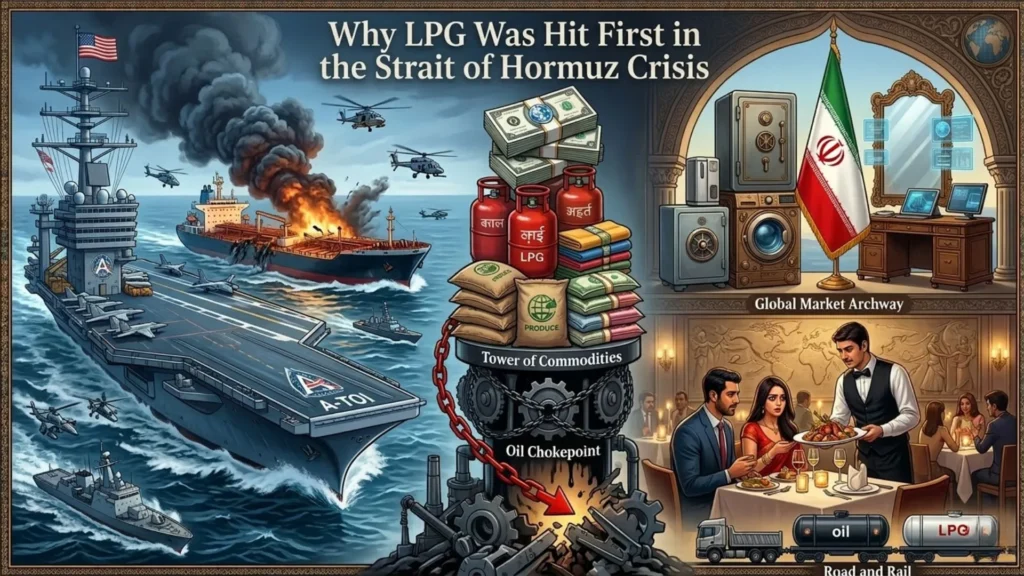
The Strait Of Hormuz: A Major Energy Bloodline.
Strait of Hormuz is among the most significant marine bottlenecks in the globe to deliver energy. Almost one-fifth of the world oil reserves are transitted through this strait making a connection between the Persian Gulf and the Arabian Sea.
To India, the region is even more critical. More than 85 percent of its crude oil is imported by the country and a big percentage of its imports is produced by the Middle Eastern states including Saudi Arabia, Iraq, Kuwait, and the United Arab Emirates.
Shipping insurance is spiked, making tanker trips risky, and supply chains come to a stop when tensions in geopolitics increase in that area. This was exactly the case with the last Iran-Israel-US conflict that has caused the Strait of Hormuz energy crisis.
Why LPG Was Hit First — Not Petrol or Diesel
Despite widespread expectations of a petrol or diesel shortage, the earliest shock came in the form of LPG supply disruption in India. Several structural factors explain this phenomenon.
1. Heavy Dependence on LPG Imports
India is a country with considerable dependence on foreign liquefied petroleum gas. Importations, grossly comprising of the Gulf countries, supply India with over 60 percent of the demands of its LPG.
This implies that any form of interruption in the shipping routes and tankers through the Strait of Hormuz has direct impacts to LPG relative to the other fuels. As the number of tanker traffic plummeted to a crawl in the conflict, LPG shipments were some of the first shipments to be delayed.
2. LPG Supply Chains are not very flexible.
Diversified supply chains of petrol and diesel. The refineries in India manufacture these fuels locally out of imported crude oil. The situation is that even in case the crude shipments reduce, the work of refineries based on the available stocks can be done.
LPG, in its turn, does not have the most storage and supply flexibility. It has to be transported in special tankers and stored at special facilities. The effect on the market is almost instantaneous when there are late deliveries.
3. Consumption by the House Hold is Huge.
There is a huge customer base of LPG in India which is one of the biggest consumer of LPG in the world due to LPG programs by the government which have widened access to clean cooking fuel. Millions of families need LPG cylinders every day.
This massive demand makes the LPG supply disruption in India more visible and immediate compared to petrol or diesel, which have broader storage and supply buffers.
4. Priority to the Domestic Consumers.
In periods of supply pressure, the governments usually give priority to household cooking gas and not industrial use. This leads to shortage in commercial activities that include restaurants and hotels first.
Commercial kitchens in big cities such as Mumbai, Bengaluru, and Chennai started complaining of delays in LPG supply and inflation. Some companies went to alternative fuels at least on a temporary basis.
The Global Economic Ripple Effect
The Strait of Hormuz energy crisis is not a regional problem, rather it has international economic consequences.
Oil fuel prices have soared high due to a fear of a protracted war. Economists project that in case the unrests persist, oil prices may go beyond 100 barrels, increasing global inflation.
In the case of India, one dollar rise in the price of oil creates an equivalent burden of about 2 billion dollars on the national import bill straining the current account deficit and detracting the rupee.
This is why the LPG supply disruption in India matters far beyond household kitchens—it directly influences inflation, trade balance, and fiscal stability.
Key Energy Imports Affected by the Hormuz Crisis
| Energy Resource | India’s Import Dependence | Impact of Hormuz Crisis |
| LPG | ~60% imported | Immediate supply disruptions |
| Crude Oil | >85% imported | Price volatility and shipping delays |
| LNG | Significant imports | Potential contract renegotiations |
| Petrol & Diesel | Mostly refined domestically | Delayed impact |
This table highlights why LPG became the first casualty during the Strait of Hormuz energy crisis.
Government Response to the LPG Supply Disruption
To stabilize the situation, India has taken several strategic steps:
- Increasing domestic LPG production at refineries
- Prioritizing household LPG supply over commercial use
- Negotiating alternative oil supplies from Russia, the United States, and West Africa
- Exploring strategic reserves to manage short-term shortages
These measures are designed to reduce the intensity of the LPG supply disruption in India and prevent panic among consumers.
Lessons for India’s Energy Security
The crisis has once again exposed the vulnerabilities in India’s energy ecosystem. Heavy dependence on imported fuels makes the economy sensitive to geopolitical shocks.
However, the situation also presents opportunities. Policymakers are increasingly focusing on:
- Expanding strategic petroleum reserves
- Diversifying energy import sources
- Accelerating renewable energy adoption
- Promoting electric mobility and alternative fuels
Such reforms could reduce the long-term risk of future Strait of Hormuz energy crisis scenarios affecting domestic markets.
What This Means for Consumers and Businesses
For households, the LPG supply disruption in India highlights the importance of efficient energy usage and exploring alternatives like piped natural gas (PNG) where available.
In the case of business especially in the hospitality and manufacturing sector, the crisis has highlighted the necessity of diversification of energy sources and back up measures.
In the meantime, financial markets are paying close attention to the Strait of Hormuz energy crisis since volatility in the energy prices can impact on inflation, currency stability as well as stock market performance.
Conclusion
Recent geopolitical warfare revealed how fast world events can influence daily life thousands of kilometers further. The LPG supply disruption in India is a direct result of supply chain vulnerabilities tied to the Strait of Hormuz energy crisis.
The high degree of importation and low responsiveness of LPG supply made LPG to be the first to meet the shortages, although petrol and diesel are relatively stable at the moment.
Since India has been and is progressing in strengthening its energy infrastructure and diversifying its energy supply sources, the lessons of this crisis would most probably be experienced in the future long term energy security strategy in country.
The message is simple in an energy market that is more interconnected throughout the world the way it has never been before: that geopolitics and household economics are more interconnected than ever.
Major economic events like the Strait of Hormuz crisis affect markets, energy prices, and your everyday expenses. Go-Finance breaks down complex financial news into simple, actionable insights. Visit GoFinance to stay ahead of economic trends.