
- 1.Why Eligibility Criteria Matter?
- 2.1. Business Vintage
- 3.2. Credit Score
- 4.3. Business Turnover
- 5.4. Profitability and Cash Flow
- 6.5. Type of Business Entity
- 7.6. Age of the Applicant
- 8.7. Banking and Transaction History
- 9.8. Income Tax and GST Compliance
- 10.9. Existing Debt Obligations
- 11.10. Required Documentation
- 12.Common Reasons for Business Loan Rejection
- 13.Tips to Improve Business Loan Eligibility
Expanding the business operations, managing the working capital, grabbing new growth opportunities and purchasing new equipment can all be done when businesses get easy access to business funding. However, before the small startups and business owners get approval for their loans, their application is thoroughly checked by the banks, NBFCs and other financial institutions for evaluating whether the business meets the lending requirements or not.
Numerous business owners consider that by having a profitable business, they qualify for secure financing. But the reality is way different. The lenders examine many factors that include factors such as credit history, annual turnover, business stability, repayment capacity and profitability. Understanding the eligibility for business loans will help entrepreneurs to prepare themselves better and also enhance their chances of getting quick approvals.
This article is a guide for first-time business loan borrowers. This guide will explain the most typical factors before sanctioning a business loan.
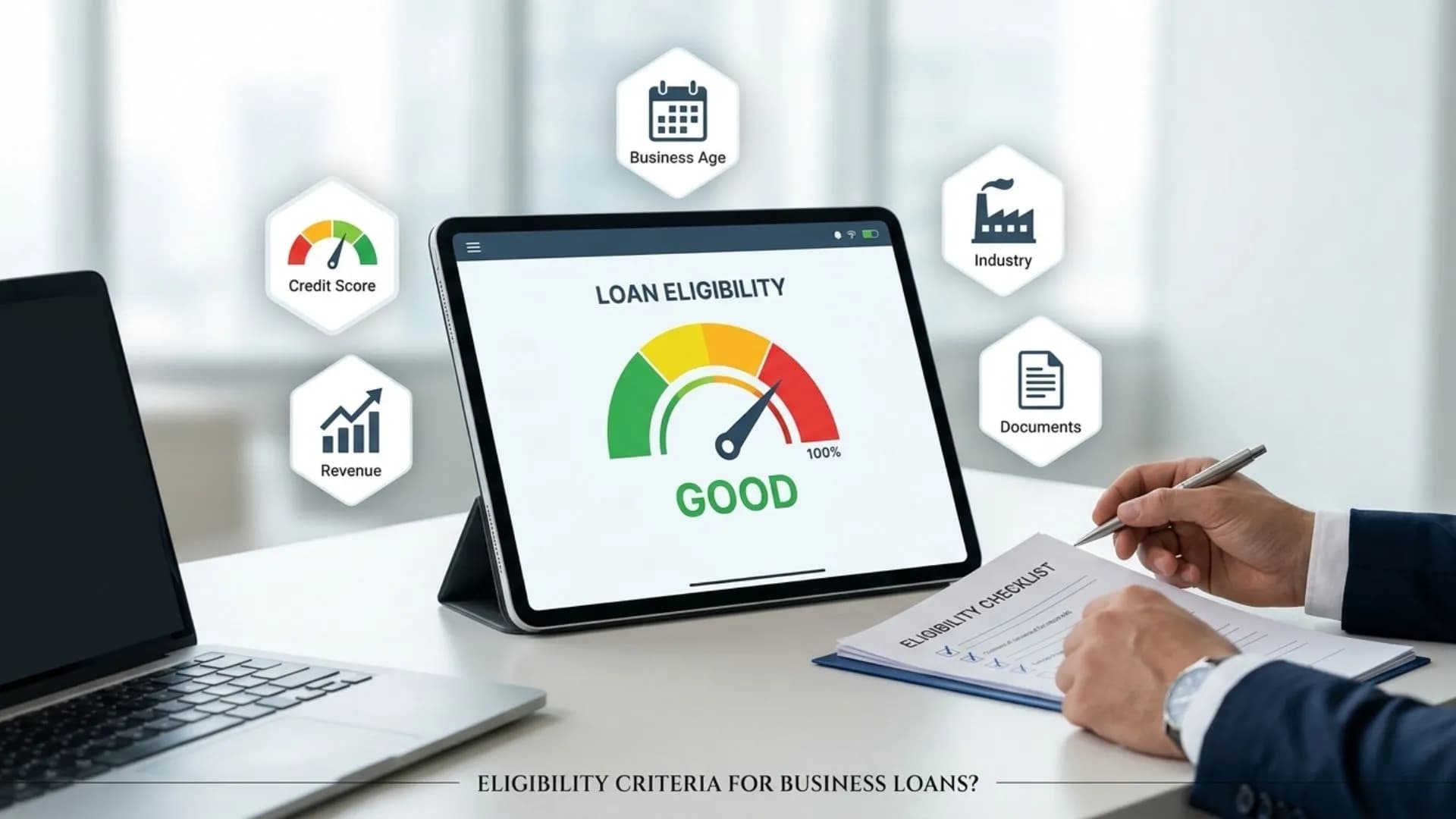
Why Eligibility Criteria Matter?
The lenders of business loans do not always have collateral to recover their funds in case of defaults, because the Business Loans taken are unsecured. As a result, the lenders are left with the option to set an eligibility criterion for the businesses to assess the risk level when lending money.
The Eligibility for Business Loans helps lenders determine:
- Whether the repayment of the loan can be done by the business or not
- The amount of the loan applied for can be approved or not
- The interest rates that can be applied
- The repayment terms and loan tenure
Better loan offers and faster approvals are typically given to those businesses that meet the required eligibility criteria.
1. Business Vintage
The tenure of the businesses is the first thing that the lenders consider when evaluating the loan application
The business loan approval totally depends on the lender, as they prefer checking the operational period of the business, which should be a minimum of 1-3 years. A longer operating history demonstrates business stability and consistent performance.
For many lenders, business vintage is a key component of the Eligibility for Business Loans because it helps assess long-term viability.
2. Credit Score
A strong credit profile significantly improves approval chances.
Lenders typically review:
- Personal CIBIL score
- Business credit history
- Previous loan repayment behaviour
- Credit card payment records
Many lenders prefer a credit score of 650 or higher, while scores above 750 often improve the chances of securing better terms and higher loan amounts.
Since credit history reflects financial discipline, it plays an important role in the Eligibility for Business Loans.
3. Business Turnover
Turnover is another important factor.
Lenders analyse:
- Annual revenue
- Monthly sales trends
- Cash flow consistency
- Business growth patterns
Some lenders specify minimum turnover requirements, while others assess turnover relative to the loan amount requested.
A healthy turnover indicates that the business has the capacity to generate revenue and manage repayments.
4. Profitability and Cash Flow
Revenue alone is not enough.
Lenders want to see:
- Consistent profits
- Positive cash flow
- Sustainable business operations
A business may have high sales but still struggle with repayments if profitability is weak. Positive cash flow is often viewed as a strong indicator of repayment capacity.
This makes profitability a critical part of the Eligibility for Business Loans.
5. Type of Business Entity
Different business structures can apply for funding.
Common eligible entities include:
- Sole proprietorships
- Partnership firms
- LLPs
- Private limited companies
- MSMEs
- Self-employed professionals
Most lenders assess financial strength and documentation rather than favouring one business structure over another.
6. Age of the Applicant
Most lenders have age requirements for borrowers.
Generally, applicants should be:
- At least 21 years old
- Not older than 65 years at loan maturity
These age limits help lenders ensure that the borrower can manage repayment responsibilities during the loan tenure.
7. Banking and Transaction History
Banks often review recent account activity before approving a loan.
They may evaluate:
- Average account balance
- Frequency of transactions
- Cheque bounce history
- Existing liabilities
A healthy banking record reflects good financial management and can strengthen the Eligibility for Business Loans.
8. Income Tax and GST Compliance
Financial compliance plays a major role in loan approval.
Lenders usually request:
- Income Tax Returns (ITRs)
- GST returns
- Financial statements
- Bank statements
Regular filing and accurate reporting demonstrate transparency and improve lender confidence.
9. Existing Debt Obligations
Before approving new financing, lenders examine current debt levels.
They assess:
- Existing business loans
- Personal loans
- Credit card obligations
- Monthly EMI commitments
A high debt burden may reduce loan eligibility because it affects repayment capacity.
10. Required Documentation
Proper documentation is essential.
Common documents include:
Personal Documents
- PAN card
- Aadhaar card
- Address proof
Business Documents
- GST registration
- Business registration certificate
- Trade license (if applicable)
Financial Documents
- Bank statements
- Income Tax Returns
- Profit and Loss statements
- Balance sheets
Keeping these documents updated can significantly simplify the application process.
Common Reasons for Business Loan Rejection
Even profitable businesses may face rejection due to:
- Low credit score
- Insufficient business history
- Poor cash flow
- Inconsistent tax filings
- High existing debt
- Incomplete documentation
Understanding these factors can help businesses strengthen their profile before applying.
Tips to Improve Business Loan Eligibility
If you want to improve your chances of approval:
- Maintain a strong credit score
- File GST and tax returns regularly
- Keep business finances organised
- Reduce unnecessary debt
- Maintain healthy cash flow
- Ensure all documents are updated
Small improvements in financial discipline can significantly enhance the Eligibility for Business Loans.
Final Thoughts
The first step towards the successful acquisition of a business loan is to understand the Eligibility for Business Loans. Before lenders make their decision, they consider various factors: business vintage, credit score, turnover, profitability, and financial discipline.
Good business practices, such as keeping records clear, having a good flow of cash, and having good repayment habits, will also increase the chances of approval and favourable terms.
For those seeking an easier way to learn about business funding options, GoFinance allows entrepreneurs to match their financial outlook and business needs with the right business loan solutions. If you're looking to borrow for working capital, expansion financing or growth financing, finding the right lending partner can make this borrowing journey much smoother.
Frequently Asked Questions
1. What is the lowest credit rating that will qualify for obtaining a business loan?
A credit score is generally considered good if it's 650 or higher, with higher scores increasing the likelihood of a loan approval.
2. Can startups get investments?
Yes. While there are no definitive rules, there are some lenders and government-backed schemes that have funding options for startups, so check with a few.
3. How many years of experience should the business have?
Most lenders will want to see business experience of 1-3 years.
4. Does the company's sales volume impact the loan application?
Yes. Turnover is important for lenders because it allows them to assess the stability of income and the ability to pay back.
5. What is the interest rate for a business loan?
Yes. Numerous banks and NBFCs provide unsecured business loans as long as the business is eligible for the loan.
Aman Yadav
Digital Marketing Expert