
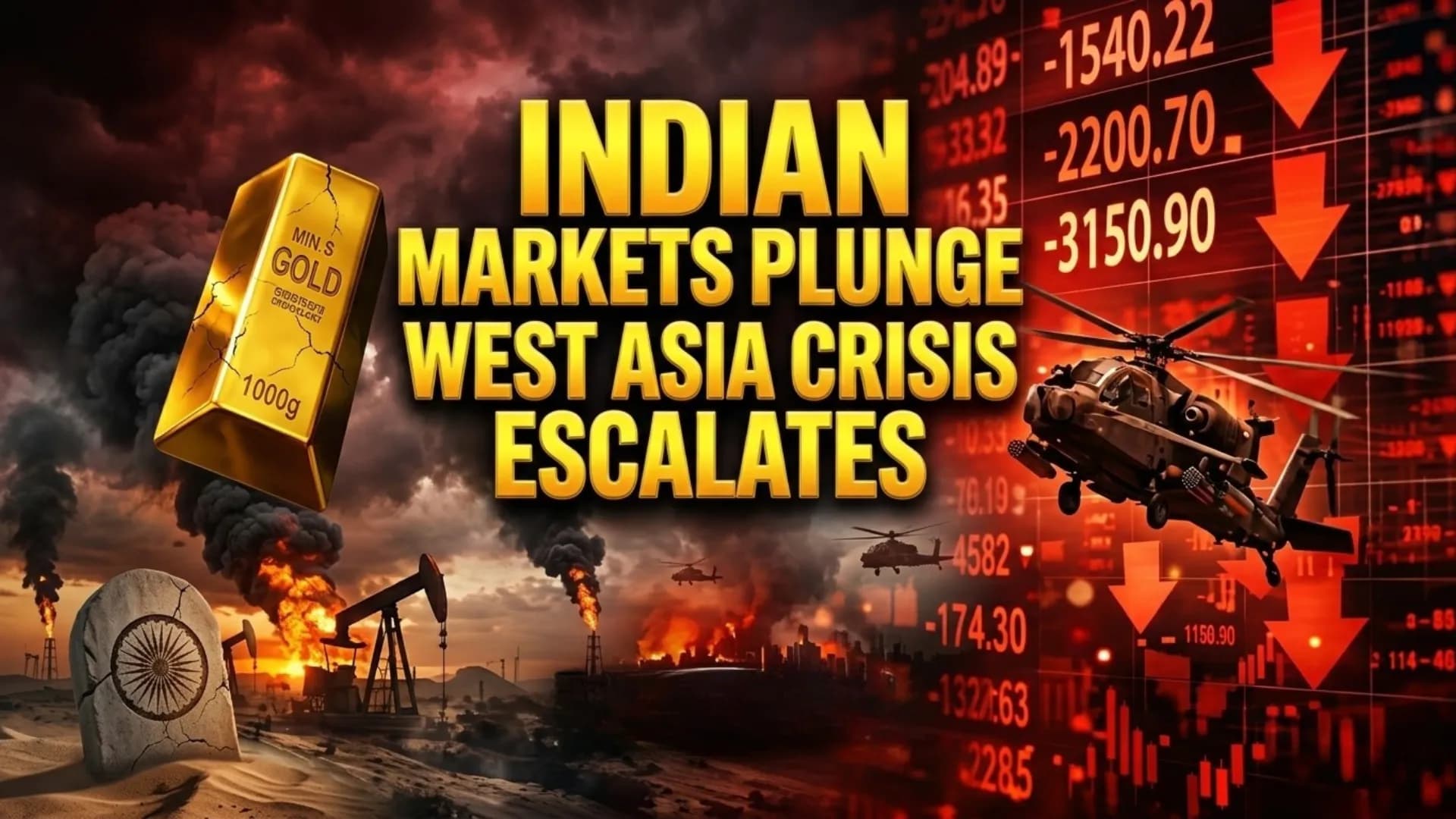
The financial markets of India underwent a serious volatility and investor panic at the beginning of March 2026, when sharp drops in benchmark equity indices were caused by increased geopolitical conflict in West Asia. The wider markets made massive losses with heavy selling in energy sensitive markets , increase in the crude prices, and risk-off trading across the globe. This rapid decrease is indicative of the geopolitical shocks which are quickly passed over into the financial market that gives impacts on domestic investors, currency strength and economic feeling.
On March 2, 2026, the India stock indices Nifty 50 and BSE Sensex, were being sold off in a sharp downward action due to the increasing internal conflict in West Asia that may cut off supplies of energy and shake the world economic stability. The Sensex dropped by more than 1,048 points (nearly 1.3%), and the Nifty 50 by over 300 points, and was by far one of the largest single day falls experienced in recent months as market reports indicated.
Geopolitical Flash Mob: Airstrike to Market Panic.
The actual trigger of this sell-off was a US Israel airstrike on Iran, which allegedly killed the Supreme Leader of Iran, a factor that increased the threat of a wider war in West Asia in which many regional countries would be involved. Pessimism among international investors including Israel and other Arab nations was caused by the retaliatory missile attacks by Iran on Israel and her neighbours and the global communities saw the intensification of the pessimism as dire threat to the stability of the region.
The world crude oil prices responded immediately to the crisis. With traders speculating about possible glitches in the supply lines of Middle Eastern oil, over 810% within one session, the price of the Brent crude soared to its highest point in months, and traders were buying at increased valuations.
The increasing oil prices are intensifying market fear.
Its economy and financial markets are highly susceptible to the price movement of energy as India relies on an excess of imported crude oil, as the majority of its crude oil consumption needs are imported. Whenever Brent crude soars unexpectedly, i.e., as in this crisis, the expectations of inflation increase, Indian rupee is depressed, and the prices of the inputs of industries that are energy dependent are high. This marriage drives corporate margin contractions and undervalues companies in industries such as aviation, automobiles and chemicals.
Investors reacted swiftly. The India VIX, also the so-called fear index, shot almost 2530 to the high point of the months, which indicated a high level of anticipating the future volatility of the market. This type of volatility tends to increase with larger increases in the movements of the indices and when investors predict greater variations in the index movements with a greater uncertainty and risk-aversion.
Sectoral Impact: Broad-Based Sell-Off
The sell-off was not confined to a handful of stocks. Reflecting broad risk-off sentiment:
- Aviation and travel firms, particularly those heavily reliant on crude fuel, suffered large declines.
- Engineering and infrastructure names, with significant exposure to West Asia projects, also lagged.
- Banks and financial services faced pressure as investors rebalanced portfolios to safer holdings.
- Consumer-oriented sectors, like paints and automobiles, saw demand expectations slide with rising input costs.
Despite the carnage, a handful of defensive sectors such as pharmaceuticals and select commodity names managed modest gains, attracting flight-to-safety flows from nervous traders.
Foreign Flow Dynamics and Domestic Cushion
The downward pressure was caused by heavy selling by Foreign Institutional Investors (FIIs). On the trade day before the big fall, the net sales of Indian stocks by the FIIs were in several thousand crores - a pattern that often occurs when the world gets nervous and its money starts to shift to what many consider safe havens, such as US Treasuries or gold.
Interestingly, Domestic Institutional Investors (DIIs) acted in a counter-way role as they intervened to purchase the equities during bargain hunting. This trend has been becoming more evident in the past several years and provides some protection against sharp corrections.
Expansive Market and Macro Implications.
As the crude price increased, the Indian rupee had been exposed to high depreciation pressure against the US dollar, which had even strengthened the global performance of poor currencies under geopolitical pressure. Weaker rupee means, in addition to increasing import bills, the possible trigger of inflation and makes it more difficult to make policy choices by the Reserve Bank of India (RBI).
Macroeconomically, the effect of increased energy prices may be to increase the current account deficit, decrease fiscal buffers, and constrain corporate profit margins - all of which discourages investor confidence and decelerates domestic demand. Nonetheless, other observers state that should the war stay within geographical boundaries or finds a speedy solution, then the stock markets will be recovering in the short run, as was experienced during earlier crisis turnarounds in times of geopolitical peace.
What This Means for Investors
- Volatility is not new: While unsettling, sharp downswings have occurred during periods of heightened geopolitical risk historically. Markets typically recover once uncertainty subsides.
- Diversification matters: Exposure to global assets, commodities, and fixed income can hedge against risk-off episodes.
- Focus on fundamentals: Long-term investors are advised to focus on strong corporate balance sheets and earnings potential rather than short-term headline risk.
Looking Ahead
The Indian market’s reaction to the West Asia crisis highlights its growing integration with global risk flows and macroeconomic linkages. Crude oil shocks, currency movements, and international fund flows can swiftly change the investment landscape. However, India’s strong domestic demand, evolving institutional participation, and resilient economic fundamentals could support recovery once geopolitical clarity improves.
As global tensions evolve, participants on Dalal Street will be watching oil prices, currency stability, and central bank responses closely — each a critical component in assessing whether this downturn is a short-lived shock or a harbinger of deeper market shifts.
Boost your business with Go Finance—get fast, flexible finance and business loans designed for your growth. We provide all types of finance and loan solutions with easy approval and reliable support.