
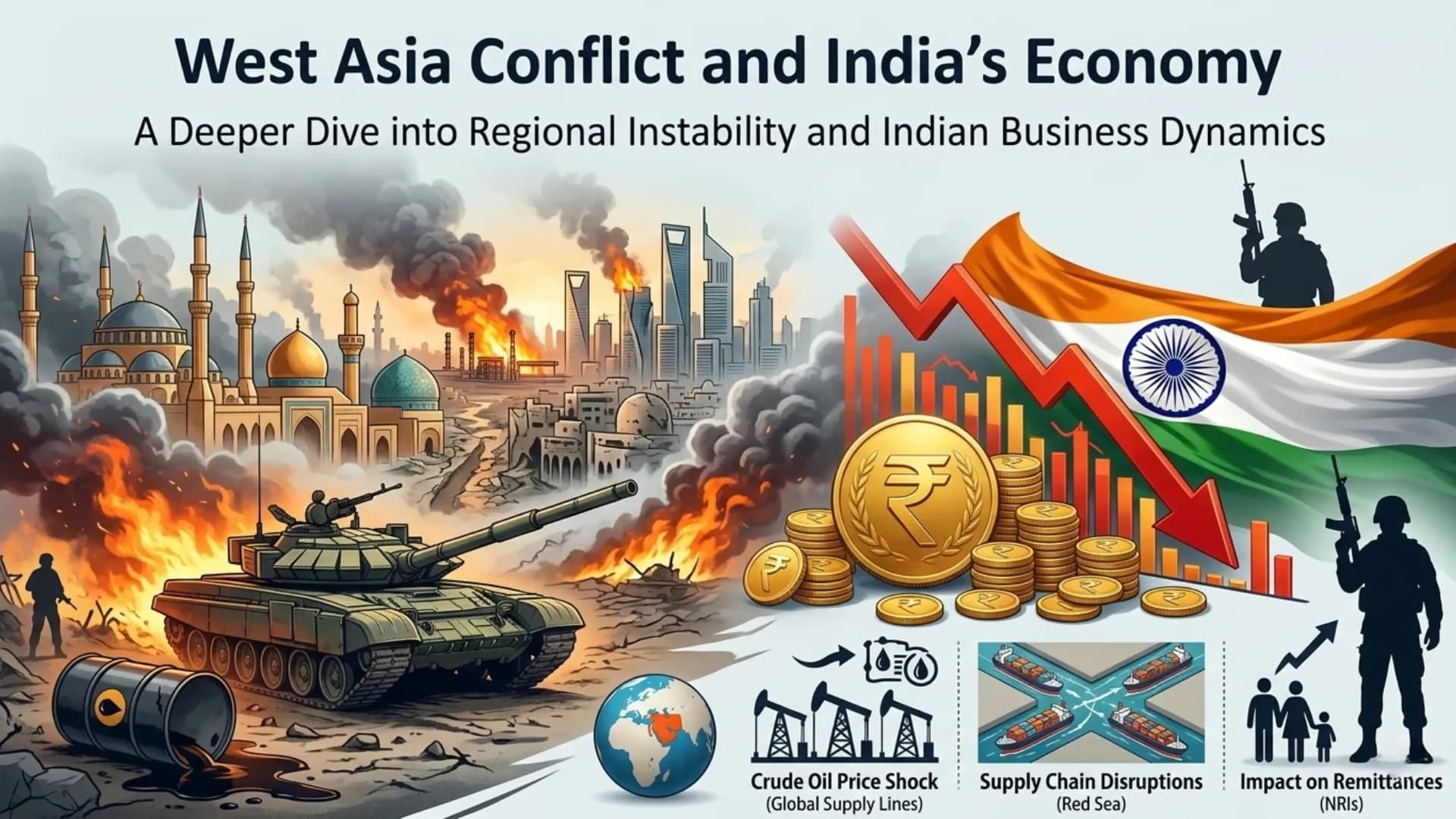
The geopolitical instability in West Asia is yet again coming out as a severe macroeconomic threat to India. The economists caution that any escalation of conflict in the Middle East would result in a surge in the price of crude oil, which will raise the inflation rate and reduce the rate at which the economy grows in one of the fastest growing large economies in the world.
India is economically fragile and vulnerable to the impact of the global energy markets due to its overreliance on imported oil. Price volatility spreads rapidly through inflation, trade balances, fiscal and financial markets when the disruption of oil supply by geopolitical tensions or shipping routes takes place. According to the recent evaluations, there is a possibility that over an extended period, tensions in West Asia would help lift the inflation level of India and strip off some of the projected GDP growth of India over the coming fiscal years.
It is important to understand the implications of these global developments on the economic prospects of India by policy makers, business, investors, and the consumers.
The importance of West Asia Geopolitics in India.
India uses over eighty five percent of her crude oil needs, which makes it one of the greatest importers of energy globally. These imports are made up of a large portion of West Asian imports such as Saudi Arabia, Iraq, the United Arab Emirates, and Kuwait.
The strategic weakness comes in the fact that, like most of the world, oil supply transits through the Strait of Hormuz, a small sea passage between the Persian Gulf and the Gulf of Oman. Approximately a third of the worldwide seaborne oil movements go through it, and as a result, it is one of the most significant energy bottlenecks in the world.
Any military or shipping disruption in this area is likely to have a quick impact on the global oil supply and the cost of oil. To India, these shocks translate to increased import bill, high transportation and inflations within the various sectors.
Already, recent geopolitical tensions have resulted in changes in the Brent crude prices where it has risen by about 73 per barrel to about 85 due to the associated instability in the area. Even the expansion of oil prices which is moderate can have big impacts on the macroeconomic indicators of India.
How Rising Oil Prices Trigger Inflation in India
Inflation in India is directly and indirectly influenced by the energy prices. The Consumer Price Index (CPI) includes fuel products like petrol, diesel or LPG but indirect consequences are frequently even greater.
As the prices of crude oil go high, the cost of transporting goods rises and prices of goods like food and agricultural products as well as industrial materials, would be exposed to inflation. Logistics are more expensive, generation of electricity is more costly and the cost of manufacturing input is also high.
The according economists project that the long-term geopolitical tensions in the West Asian region might raise the inflation of the consumer price in India by about 10 -20 basis points when the oil prices are high.
The new framework of Indian CPI basket has been one of the reasons behind the inflation sensitivity. Components of the fuel expenditure have acquired a much greater weight than during periods when the measurements of inflation had been taken previously and thus, general inflation has become more sensitive to variations in the cost of energy.
Also, in case oil marketing firms transfer their global prices to the consumer by increasing fuel prices, the effect of inflation is more obvious and direct.
The government however on some occasions come in to save the situation by lowering fuel taxes or absorbing part of the cost increment temporarily. Although this can cushion the effect on the consumers, it can create fiscal pressure or decrease income.
Possible effect on the growth of the GDP of India.
The issue of oil prices does not solely impact on inflation, but also on the growth of the economy. Energy is one of the most significant inputs in almost all sectors so the cost of conducting business is costly in case of increasing fuel expenses.
According to the economic estimates, 10 percent growth in the price of crude oil will pull the real GDP growth of India down by approximately 15 basis points. The effect is manifested in a number of ways:
To start with there is the increased cost of operation to the businesses which may cut down on their profitability and the ability to invest. Second, the consumer can reduce discretionary expenditure where household incomes are compelled by the increase in fuel and transportation prices. Third, industries that are fuel-intensive get their margins diminished like the airline industry, logistics, and manufacturing.
With the way the geopolitical tension continues and oil prices maintain their high level over a long period of time, economists project that the drop in economical growth in India is likely to be approximately 2030 basis points.
This decline is not a big factor, but even slight changes in the growth rate of the GDP can lead to major economic impacts of a nation with a multi-trillion-dollar economy.
Pressure on India’s Current Account Deficit
The deficits in the current account (CAD) is one of the most immediate financial effects of increasing oil prices. The CAD is used to gauge the disparity between imports and exports of goods and services of a nation.
Since oil is the largest import product in India, high prices of crude products directly impact the impact of the country through an increase in the import bill.
According to economic forecasts, should the prices of crude oil continue to stay above 80 per barrel in the long run, there will be an increase in the current account deficit of India to 1.3 to 1.8 percent of the GDP.
The world over, each 10 percent rise in the price of oil has expanded the CAD of India by about 0.4 percent of GDP.
An increased current account deficit would put pressure on the rupee and make imports more costly and they cause additional inflationary pressure. The depreciation of the currency also has the effect of increasing the servicing of the foreign debt and it can also affect the sentiments of the investors in the financial market.
Global Economic Spillovers
India is not the only country that is affected by the dynamics of West Asia tensions. The increase in oil prices also has the tendency to experience inflation globally, which may affect the decision of the monetary policy by the central banks of such countries like the Federal Reserve of the United States.
In case of an increase in global inflation due to elevated energy prices, central banks can postpone the lowering of the interest rates or retain the current tight financial policy. This has the potential of lowering capital flows to emerging markets and the financial volatility.
In the case of India, the stricter financial conditions in the world would have implications on the equity markets, foreign investment inflows and the currency stability.
How India Can Mitigate the Economic Risks
Irrespective of these weaknesses, there are various policy mechanisms that India could use to lessen the effect of geopolitical shocks on its economy.
Diversifying oil sources to imports is one of them. India has since been purchasing more crude oil in the past years, specifically in Russia or the United States of America in order to decrease their dependence on the Middle East suppliers.
The other approach is trying to increase strategic petroleum reserves, which enable the country to have emergency petroleum when the oil is disrupted temporarily.
Fuel taxes and excise charges can also be modified by the government to make the domestic fuel prices stable in the volatile times of the world. In the meantime, monetary policy instruments can help the reserve bank of India to keep the inflation rates in check without compromising financial stability.
In the long-term, the faster realization of the transition to renewable energy and the development of electric mobility can decrease the dependence of India on the foreign markets of fossil energy.
Outlook for India’s Economy
Although the conflict between the West Asia presents evident threats in the short term, the overall economic fundamentals of India are rather good. A strong internal demand, an increasing production capacity, and the ongoing support of infrastructures are the sources that act as the safeguard to the external shocks.
Nevertheless, the tendency in oil pricing will continue to be a major unpredictable variable in the economic prospects in India over the next few years.
The inflation and fiscal pressures may increase even further in case there are more geopolitical tensions and disruptions to the oil supply. On the other hand, in case of the stabilization of the situation in the region and the normalization of energy markets, the growth momentum of India can actually stay relatively intact.
Monitoring of energy market and geopolitical trends in the world will be critical to investors, policymakers as well as businesses to cope with the changing economic future.
Boost your business with Go Finance, get the fast, flexible finance and business loans needed to grow your business. We also offer any kind of finance and loan that is easily approved and reasonably backed.