
- 1.Introduction: A Strategic Shift in India’s Growth Narrative
- 2.What Is the Orange Economy?
- 3.Key Characteristics of the Orange Economy
- 4.Why Gen Z Is at the Center of This Transformation
- 5.Policy Backing: Nirmala Sitharaman’s Orange Economy Vision
- 6.The Role of Banking and Finance in Scaling Creative Careers
- 7.How Financial Institutions Are Adapting
- 8.Real-World Examples: From Hobby to High-Income Career
- 9.Economic Impact: Job Creation Without Job Loss
- 10.Challenges That Must Be Addressed
- 11.The Future: Informal Hustle to Formal Economy.
Introduction: A Strategic Shift in India’s Growth Narrative
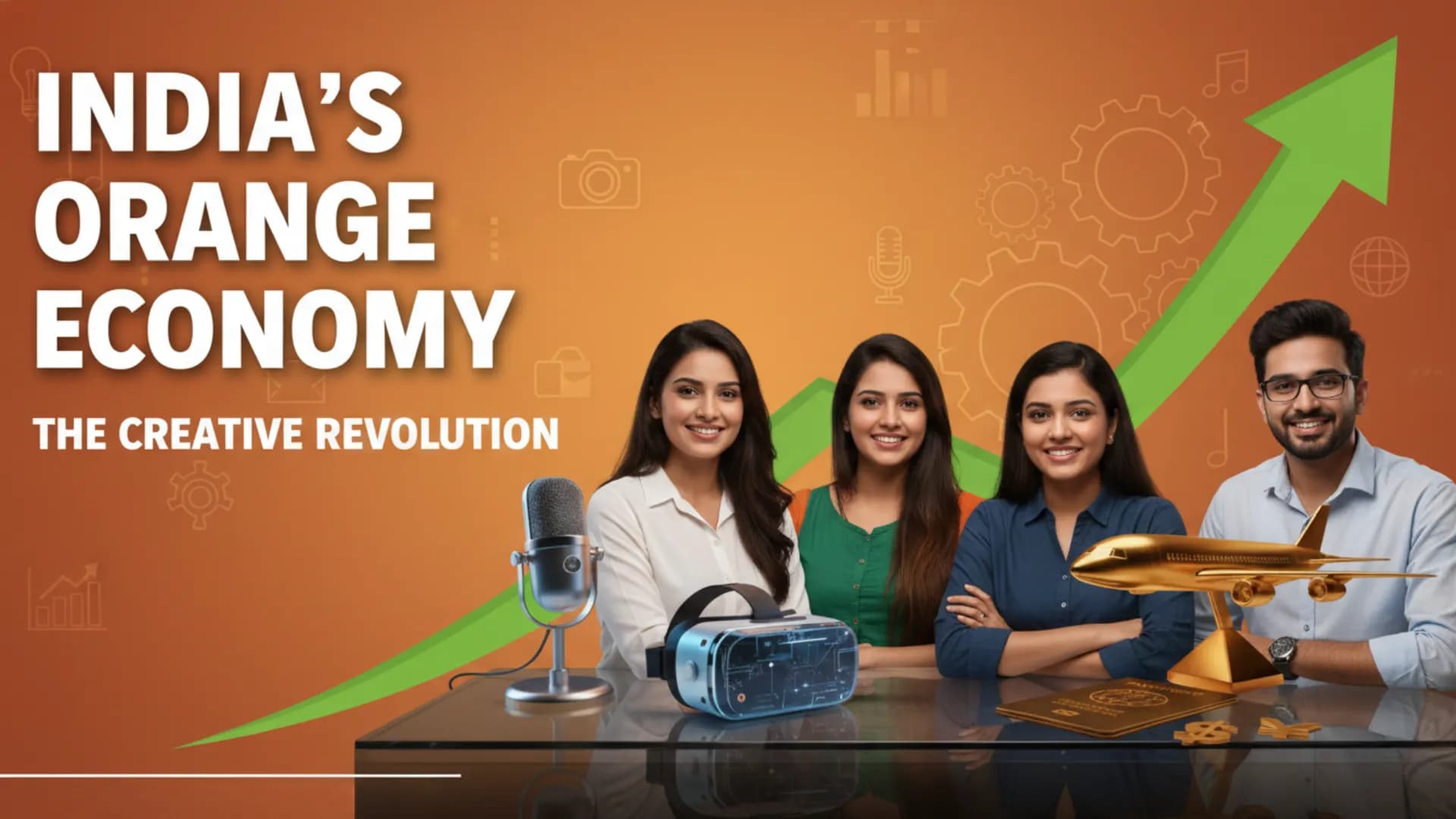
The story of the economic growth of India is submitting a silent but revolutionary change. On top of the manufacturing, infrastructure, and digital public goods, policymakers are currently shifting their focus towards an alternate engine of value creation ,India’s Orange Economy. Elevated in recent policy discourse and featured by Finance Minister Nirmala Sitharaman , the Orange Economy is the commodification of creative and cultural mediums, content and passions based skills, particularly among Gen Z and young millennials.
According to The Financial Express, this strategic bet is meant to transform the hobbies, including gaming, contents, music, design, animation, and digital storytelling, into sustainable, bankable, and scalable incomes. At a time when the traditional labor markets are experiencing stress and the possibility of automation is replacing manual jobs, the Orange Economy provides India with a rare chance to bring its demographic dividend in line with the demands of the contemporary world in creative and digital labor.
What Is the Orange Economy?
Orange Economy is defined as economies that are inspired by creativity, intellectual property, culture, and the digital expression. It was first coined by the Inter-American Development Bank, but its application has taken on a new nature in India with large access to internet, low-cost smart phones and digital payment systems.
The Orange Economy is a financial sector unlike traditional ones that do not monetize assets, factories, or talents. It contains the online gaming, animation, graphic design, online gaming, music production, film making, influencer marketing, podcasting, UX /UI design, and new fields like virtual reality and AI-assisted creativity.
Key Characteristics of the Orange Economy
| Attribute | Traditional Economy | Orange Economy |
| Core Asset | Physical capital | Intellectual & creative capital |
| Entry Barriers | High | Relatively low |
| Workforce | Degree-driven | Skill- and portfolio-driven |
| Scalability | Capital-intensive | Platform-driven |
| Revenue Model | Salaries & manufacturing | Royalties, ads, subscriptions |
This shift is particularly relevant for India, where millions of young people possess skills that fall outside traditional employment frameworks.
Why Gen Z Is at the Center of This Transformation
The young people aged above 1997 are the Gen Z population of India who have been introduced to a digital-first world. An industry reckoning shows that more than three out of five of Indian Gen Z users are involved in content creation, gaming, or digital freelancing in one way or another. What used to be heard as timepass, is becoming a source of legitimate income.
YouTube, Instagram, ShareChat, Moj, Spotify and gaming ecosystems have decreased the entry barrier and allowed Tier-2 and Tier-3 city creators to reach the world. As mentioned in the Financial express article, the policymakers have realized this change and are in the process of solidifying it in the Indian economic framework.
Policy Backing: Nirmala Sitharaman’s Orange Economy Vision
The focus of the Orange Economy provided by Finance Minister Nirmala Sitharaman is indicative of a larger policy rethink. Government is looking at how to support passion-driven careers with financing and skilling in addition to digital infrastructure instead of pushing youth into conventional job sectors.
A number of current projects are indirectly in support of this ecosystem:
- Digital India has ensured affordable broadband and smartphone penetration.
- Startup India enables creator-led startups and IP-driven ventures.
- Skill India programs are increasingly including design, animation, and digital marketing.
- UPI and fintech innovation allow micro-earnings, subscriptions, and global remittances.
This policy environment is crucial because creative careers often fail not due to lack of talent, but due to lack of financial recognition and institutional support.
The Role of Banking and Finance in Scaling Creative Careers
One of the biggest challenges faced by creators is financial legitimacy. Traditional banks often struggle to assess irregular income, platform-based earnings, or intellectual property value. However, this is changing rapidly.
How Financial Institutions Are Adapting
| Area | Traditional View | Emerging Approach |
| Income Assessment | Fixed salary slips | Platform earnings & contracts |
| Creditworthiness | Employment history | Digital cash flows |
| Collateral | Physical assets | IP & brand equity |
| Payments | Monthly salary | Real-time micro-payments |
Fintech companies are now offering creator-focused financial products, including instant payouts, revenue analytics, GST compliance tools, and short-term working capital loans. Some banks are also piloting cash-flow-based lending models, which analyze creator income patterns rather than employment status.
Real-World Examples: From Hobby to High-Income Career
India already possesses a number of success stories which support the thesis of the Orange Economy:
- Gaming and Esports: Indian gamers have an opportunity to earn money now through tournaments, sponsorships and live streaming. It is projected by the industry reports that the Indian gaming industry will reach USD 8 billion by 2027.
- Local Content Producers: Content creators generating content in Hindi, Tamil, Telugu, and Bhojpuri are getting huge viewership and making their money by placing ads, by brand partnerships and by subscribing to fans.
- Design and Freelancing: Indian UX designers and illustrators are working with clients across the globe, through platforms such as Fiverr, Upwork and Toptal and are earning in foreign currencies.
These illustrations show that creativity, when applied to digital platforms, and access to funds can result in sustainability income.
Economic Impact: Job Creation Without Job Loss
The strongest side of Orange Economy is that it creates jobs without core employment jobs being displaced. Creative jobs unlike automation based industries tend to complement the already existing sectors of marketing, education, entertainment and technology.
Estimates by the world show that creative industries offer a global GDP contribution of above 3% and are also known to employ approximately 50 million individuals around the globe. In the case of India, even a small increase in this industry would be used to absorb millions of unemployed youths who are underemployed.
Challenges That Must Be Addressed
In spite of prospects, the Orange Economy has a number of challenges in its structure:
- Volatile income, as a result of changes in the algorithm or dependence on the platform.
- Social security like pensions, health insurance or lack thereof.
- Protection issues within the IP like content piracy.
- Poor economic education of young creators.
It will take partnership between policymakers, banks, platforms, and learning institutions in order to help address such gaps.
The Future: Informal Hustle to Formal Economy.
The Orange Economy is not just a trend, but a transformative event that shows that value is no longer created and felt the same way. India will open a huge pool of untapped talent by recognizing creative work as an economic output on formal basis.
The emphasis of Nirmala Sitharaman on this industry can be attributed to the knowledge about the future of employment not just being factories and offices, but also studios, screens, and smart phones.
The Orange Economy has the potential to be very inclusive and robust in development by the right combination of policy support, financial innovation and skill development.
Conclusion
India is at the intersection of the demographic and digital and creative ambition. The Orange Economy is a one of kind chance to translate the young energy into economic value. India is not just changing the face of work with Gen Z passions as lawful employment, but it is redefining its growth narrative, too, in the digital era.
Grow your business lenders- Boost your business with Go Finance- get fast and flexible business and finance loans to help you grow. We also offer any kind of finance and loan solutions easily approved and financially guaranteed.