
- 1.Understanding the Co-Lending Model in Modern Banking
- 2.Why the Focus on Home Loans and Gold Loans?
- 3.Banking Industry Strategic Advantages.
- 4.Impact and Benefits for Customers
- 5.Strengthening Financial Inclusion in India
- 6.Technology and the Future of Retail lending.
- 7.Why This Development Matters for Readers
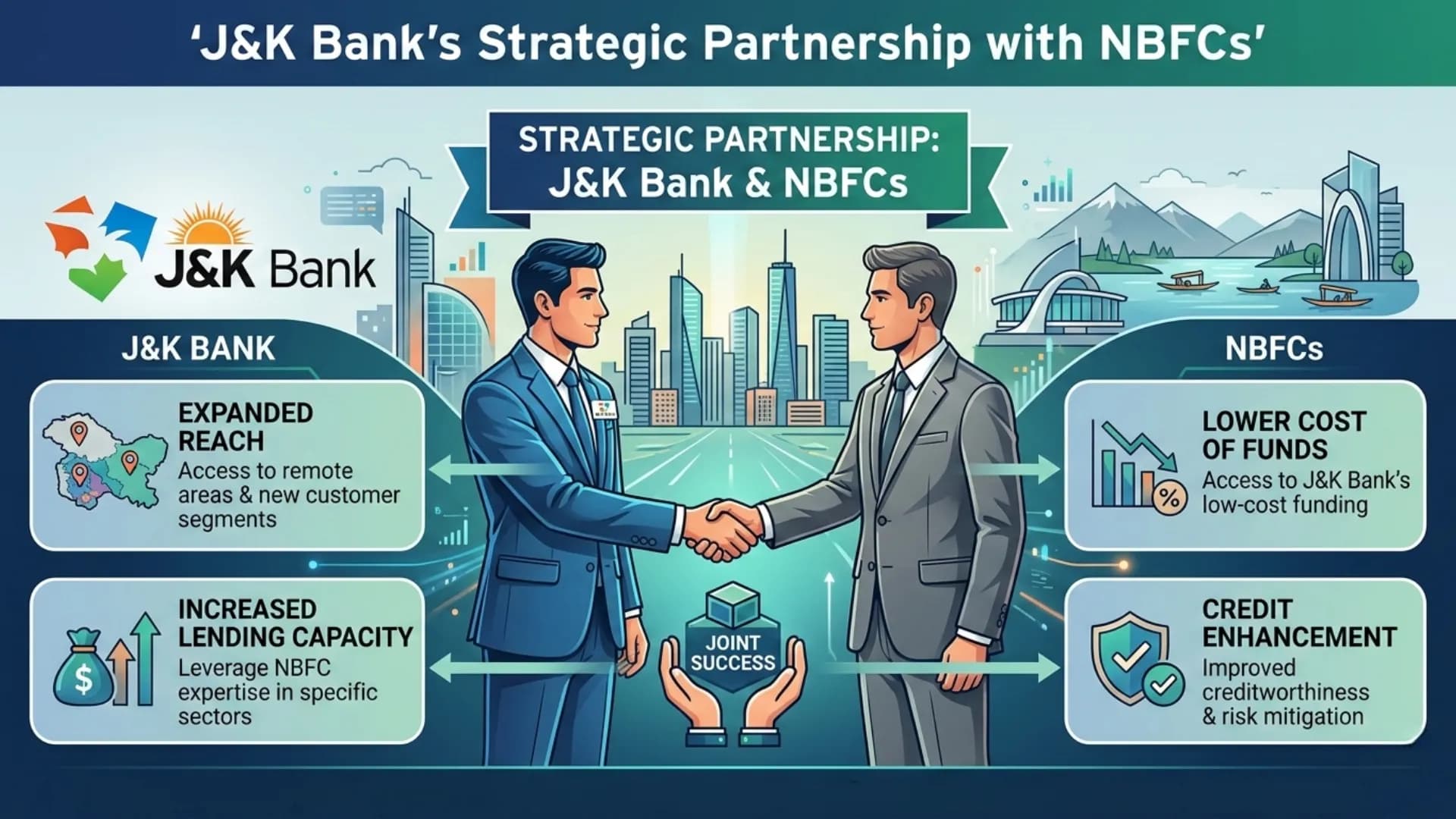
The banking industry in India is experiencing a revolution characterized by teamwork, technological breakthroughs, and evolving consumer credit needs. The J&K Bank NBFC partnership is a notable example of this shift, as Jammu & Kashmir Bank has joined hands with mid-tier non-banking financial companies (NBFCs) to expand its reach in the home loan and gold loan segments. The bank has entered into co-lending agreements with Home First Finance Company India Limited for housing finance and IIFL Finance for gold loans, aiming to expand credit access and strengthen retail lending across India.
This project is indicative of a greater trend within India in the financial ecosystem, with banks and NBFCs joining forces to leverage their advantages together: with the infrastructure and cheap money of banks, and the expertise of specialized lending. The goal of the partnership is to enhance the availability of credit, faster loan approval, and financial access on emergent economies.
Understanding the Co-Lending Model in Modern Banking
This partnership is functioning under the co-lending principle, which is promoted by the Reserve bank of India to enhance the flow of credit to the sectors that are underserved. Under this structure, a bank and an NBFC co-finance a loan to the customers and share risks and operational burdens.
Indicatively, the bank has been able to offer its solid deposit base and extensive branch sector, whereas the NBFCs have extended experience in setting up customers, creditworthiness evaluation, and specialty offering. Officials of Jammu & Kashmir Bank stated that this type of model allows quicker delivery of credit and better connectivity with the customers, particularly in the markets other than they had traditionally dominated in Jammu and Kashmir.
Through NBFC technology platforms and underwriting capabilities, the bank will be in a position to handle loan applications better without contravening regulations and risk control.
Why the Focus on Home Loans and Gold Loans?
The decision of undertaking home loans and gold loans is the strategic decision since they are some of the fastest-growing sectors of the retail credit market in India.
The housing finance continues to play the key role in economic growth and urban development. As the number of people migrating to the city comes with increased urbanization and government rewards like affordable housing programs, the number of people who need loans to buy houses has been increasing. The bank can also access a borrower base that is growing fast through joining forces with Home First Finance which deals specifically with the housing finance of middle-income and first-time buyers.
Meanwhile, such loans as gold loans have experienced a massive expansion over the last few years. The increment of gold prices and extensive demand in securitized lending has brought the industry to a new height. By late 2025, the exceptional gold loan portfolio of India had shot up to approximately 3.5 lakh crore, indicating a dramatic development of the borrowers seeking quick credit through gold jewelry.
Gold loans are particularly common with small businesses, farmers and households that need short term liquidity. They are also rated as being comparatively low-risk to lenders owing to being supported by concrete collateral.
Banking Industry Strategic Advantages.
The alliance underscores a significant change in the Indian banking industry. Banks once controlled the huge lending in the past, and NBFCs operated in the niche market and quick loan facility. These days there has been a more and more blurred line between the two where competition is substituted with collaboration.
In the case of Jammu and Kashmir Bank, the partnership presents an avenue of diversifying its loans and establishing a presence to the outside of the Union Territories within which it has been operating. It has been observed that the bank is busy expanding its rest of India business to cut down on the risk of geographic concentration and help it develop sustainable long term growth.
The partners of NBFC also have the advantage of being able to tap into the funds base of the bank which most of the times will provide more affordable borrowing rates than their independent financing of NBFCs. This assists in the minimization of interest rates to be paid by borrowers, and the lending activities are enlarged.
Impact and Benefits for Customers
For individuals and businesses, the partnership could translate into several practical benefits.
One of the most significant advantages is faster access to credit. By combining the digital infrastructure of NBFCs with the established banking network of Jammu & Kashmir Bank, customers may experience quicker loan approvals and smoother documentation processes.
Another major benefit is improved financial accessibility. Many borrowers in semi-urban and rural areas struggle to access traditional bank loans due to strict credit requirements. NBFCs typically have greater flexibility in evaluating borrowers, making it easier for individuals without extensive credit histories to obtain financing.
In the housing segment, this could help first-time homebuyers secure affordable loans for purchasing property. In the gold loan segment, individuals can use their gold assets to access emergency funds without selling family jewelry or valuables.
Small entrepreneurs and micro-business owners are also likely to benefit. Gold loans often serve as working capital for small businesses, enabling them to manage inventory, expand operations, or cover short-term cash flow needs.
Strengthening Financial Inclusion in India
The mutual goal of the partnership is to ensure financial inclusion, meaning that increased access to formal financial services is availed to more people and businesses.
India has been struggling with the issue of providing credit to under-serviced groups or rather rural and semi-urban areas. There are numerous families who depend on informal lenders who have very high rates of interest. The banks and NBFCs can offer safer and cheaper credit by making secured lending by home and gold loans more available.
The data on the industry also indicates that the potential of the market of gold loans remains enormous. India has one of the largest private gold stocks in the world; however very little of this is provided as loan collaters. This asset base may have a significant liquidity position of households and businesses as awareness increases and the financial services diversify.
Technology and the Future of Retail lending.
The technology-based lending is another major reason that led to this partnership. The automation of risk scoring, computer-based verification, and online applications are some of the modern loan platforms that minimize the time of processing, and enhances the accuracy of the process.
Jammu & Kashmir Bank already has digitalized the housing and gold loan application systems that also incorporate credit bureau review and automated risk management. These systems allow making decisions faster and enhance customer experience through less paperwork and short waiting times.
Such platforms together with NBFC fintech capabilities can be used to dramatically speed up credit granting and can promote the efficiency of functions.
Why This Development Matters for Readers
It is imperative to understand the changes such as this one as they have a direct impact on the way individuals participate in the credit market and the use of finance. The partnership between banks and NBFCs is an indication of a change in favor of speedy, more integrative, and technologically empowered lending.
To consumers, this will be expanded number of loan facilities, low interest rates, and faster loan acquisition procedures. It may make property funding easier to the potential homeowners. It can offer simpler access to a smaller entrepreneur to working capital in the form of gold-backed loans.
In a bigger view such partnerships also make the financial ecosystem stronger as they promote cooperation, innovation and sound credit growth.
The Road Ahead
The relationships between banks and NBFCs will probably increase as the financial sector of India developed. These partnerships enable institutions to pool their assets at the same time meeting the increasing retail credit demands.
In the case of Jammu & Kashmir Bank, the Home First Finance and IIFL Finance cooperation is not only an expansion of lending to their clients but also a step towards a greater scheme of improving its processes, expanding toward new client segments and assisting in the economic development in the whole of India.
Finally, efforts such as this point to the fact that the banking industry is changing and adjusting to a dynamic financial environment. The partnership would not only enhance the business strategy of the bank; it is a way of providing real value to millions of people who are trying to access their financial services plus the home and gold loans in a reliable and accessible manner.
Never miss important updates from India’s banking and finance industry.
Subscribe to our newsletter for timely news and insights