
- 1.Why are government loan schemes important?
- 2.Pradhan Mantri Mudra Yojana (PMMY)
- 3.2. Credit Guarantee Fund Trust for Micro and Small Enterprises (CGTMSE)
- 4.3. Stand-Up India Scheme
- 5.4. Prime Minister's Employment Generation Programme (PMEGP)
- 6.5. SIDBI MSME Loan Schemes
- 7.6. Startup India Support
- 8.Government Schemes vs Regular Business Loans
- 9.Who Can Apply?
- 10.Documents Commonly Required
- 11.How to Choose the Right Loan?
- 12.Benefits of Choosing the Right Financing
Availability of finance is one of the biggest hurdles for small-scale business owners in India. Choosing the right type of loan can boost up your company, whether you plan on starting your business, expanding it or are looking to purchase some machinery or inventory.
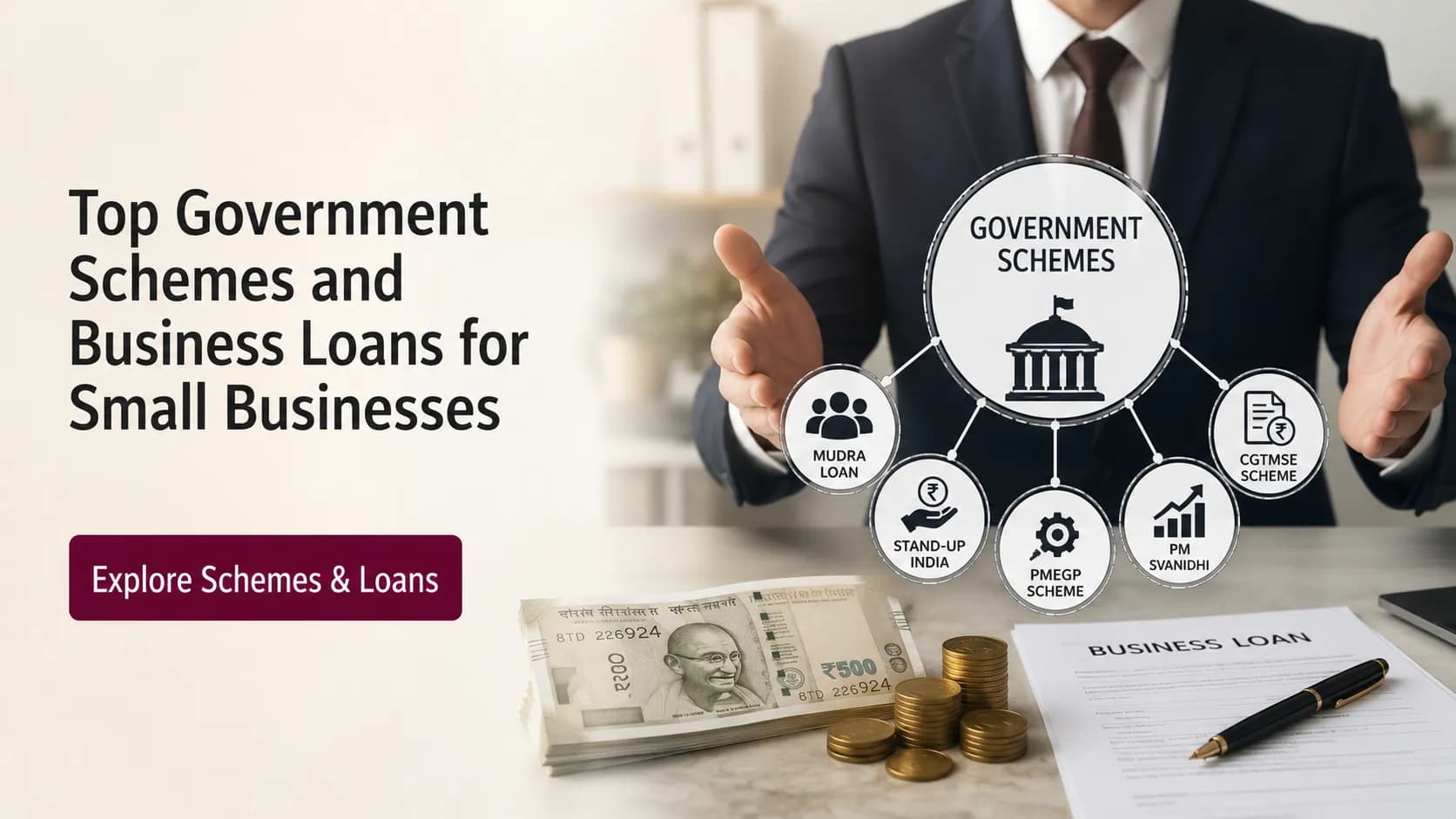
Fortunately, the Government of India has provided several loan for small business owners with various schemes, making it easier for them to obtain loans. Apart from these schemes, banks, NBFCs and online digital platforms also have facilities to lend money, taking into account the needs of MSMEs and start-ups.
Applicants of loan for small business with knowledge of government schemes and financing options could help them decide on an appropriate solution in 2026.
Why are government loan schemes important?
MSMEs (micro, small and medium enterprises) contribute a significant part of the Indian economy. They offer employment, innovation and export their goods to various countries. Recognizing this fact, the government has brought some financial programmes for small entreprises to ease their credit access.
Many government-backed schemes offer:
- Collateral-free loans
- Lower borrowing costs
- Credit guarantee support
- Interest subsidies
- Easier loan access for eligible businesses
The advantages do make them an appealing choice for the entrepreneur that needs a loan for business.
Pradhan Mantri Mudra Yojana (PMMY)
The Pradhan Mantri Mudra Yojana (PMMY) continues to be one of the most popular government financing schemes for micro and small businesses.
It supports:
- Retail businesses
- Traders
- Manufacturers
- Service providers
- Small entrepreneurs
The scheme offers loans under different categories:
Category | Loan Amount |
Shishu | Up to ₹50,000 |
Kishore | ₹50,001 to ₹5 lakh |
Tarun | ₹5 lakh to ₹10 lakh |
Mudra loans are generally collateral-free, making them an excellent loan for small business owners who may not have assets to pledge.
2. Credit Guarantee Fund Trust for Micro and Small Enterprises (CGTMSE)
Many businesses struggle to obtain loans because they lack collateral.
The CGTMSE scheme addresses this challenge by providing credit guarantees to lenders, encouraging them to approve loans without traditional security.
Key benefits include:
- Collateral-free financing
- Easier loan approval
- Support for MSMEs
- Reduced lender risk
This scheme is especially beneficial for businesses seeking a loan for small business without offering property or other assets as security.
3. Stand-Up India Scheme
The Stand-Up India Scheme promotes entrepreneurship among women and SC/ST entrepreneurs.
Eligible applicants can receive:
- Term loans
- Working capital support
- Funding for new business ventures
Loan amounts generally range from ₹10 lakh to ₹1 crore for eligible greenfield enterprises.
4. Prime Minister's Employment Generation Programme (PMEGP)
The PMEGP supports first-time entrepreneurs by encouraging self-employment through financial assistance.
The scheme benefits:
- Manufacturing businesses
- Service enterprises
- Rural entrepreneurs
- Urban entrepreneurs
Depending on eligibility, applicants may also receive subsidies in addition to loan assistance.
5. SIDBI MSME Loan Schemes
The Small Industries Development Bank of India (SIDBI) offers several financing programmes designed specifically for MSMEs.
Funding can be used for:
- Business expansion
- Technology upgrades
- Equipment purchases
- Working capital
- Capacity enhancement
SIDBI continues to play an important role in strengthening India's MSME ecosystem.
6. Startup India Support
For startups, the Government's Startup India initiative provides access to various financial and non-financial support programmes.
Benefits include:
- Funding support
- Incubation assistance
- Regulatory support
- Startup ecosystem development
Entrepreneurs can explore different schemes depending on their industry and business stage.
Government Schemes vs Regular Business Loans
Not every business qualifies for government schemes.
Here's a simple comparison:
Government Schemes | Regular Business Loans |
May offer subsidies | Usually market-based interest rates |
Often collateral-free | Secured and unsecured options available |
Eligibility depends on scheme | Wider eligibility options |
Processing may take longer | Faster approvals in many cases |
Designed for specific business categories | Suitable for various funding requirements |
Businesses should compare both options before making a decision.
Who Can Apply?
Eligibility varies depending on the scheme, but applicants generally include:
- MSMEs
- Startups
- Sole proprietors
- Partnership firms
- LLPs
- Private limited companies
- Manufacturers
- Retail businesses
- Service providers
Many schemes also require Udyam Registration and compliance with applicable business regulations.
Documents Commonly Required
When applying for a loan for small business, lenders or government agencies generally request:
Personal Documents
- PAN Card
- Aadhaar Card
- Address proof
Business Documents
- Business registration certificate
- GST registration (if applicable)
- Udyam Registration
Financial Documents
- Bank statements
- Income Tax Returns
- GST returns
- Profit and Loss statements
Keeping these documents updated can improve approval timelines.
How to Choose the Right Loan?
Before selecting any financing option, consider:
- Why do you need funding?
- How much capital is required?
- Can you comfortably repay the loan?
- Do you qualify for a government scheme?
- Would a private lender offer faster approval?
The right loan for small business depends on your business stage, funding requirement, and repayment capacity.
Benefits of Choosing the Right Financing
Selecting the right funding solution offers several advantages:
- Improved cash flow
- Business expansion opportunities
- Better inventory management
- Equipment upgrades
- Increased operational efficiency
- Long-term business growth
Finance can be used to ensure sustainable growth and financial stability for businesses.
Final Thoughts
The government-backed financing has made it easier than ever for entrepreneurs to obtain a loan for small business. PMMY, CGTMSE, PMEGP, Stand-Up India and SIDBI have been continuing to support startups and MSMEs with the provision of low-cost loans and easing borrower barriers.
But government schemes are not always suitable and sometimes don't offer instant funding. GoFinance can help you look at business loan solutions that suit your needs if you're seeking quicker approvals, flexible repayments and guidance from the experts. If you're seeking government or private business financing, GoFinance makes it easy to compare options and select the financing fit for your business's objectives.
Aman Yadav
Digital Marketing Expert