
The retirement scenario in India is changing drastically due to the launch of NPS Sanchay by the Pension Fund Regulatory and Development Authority (PFRDA) which is a simplified pension solution. To offer long-term retirement security to the millions of unorganized small businessmen, farmers, domestic workers, laborers, drivers, self-employed persons, and gig workers who have not had any scheme providing regular pension benefits, the scheme is created keeping the Indian masses in mind.
Having built upon the success of KBC, NPS Sanchay could be one of the most impactful financial inclusion schemes of recent years, as almost 90% of India’s workforce is in the informal sector. The scheme not only makes investments easy but also makes them simple to choose and by investing in the scheme even a novice investor can develop a retirement corpus without getting financial knowledge fatigue.
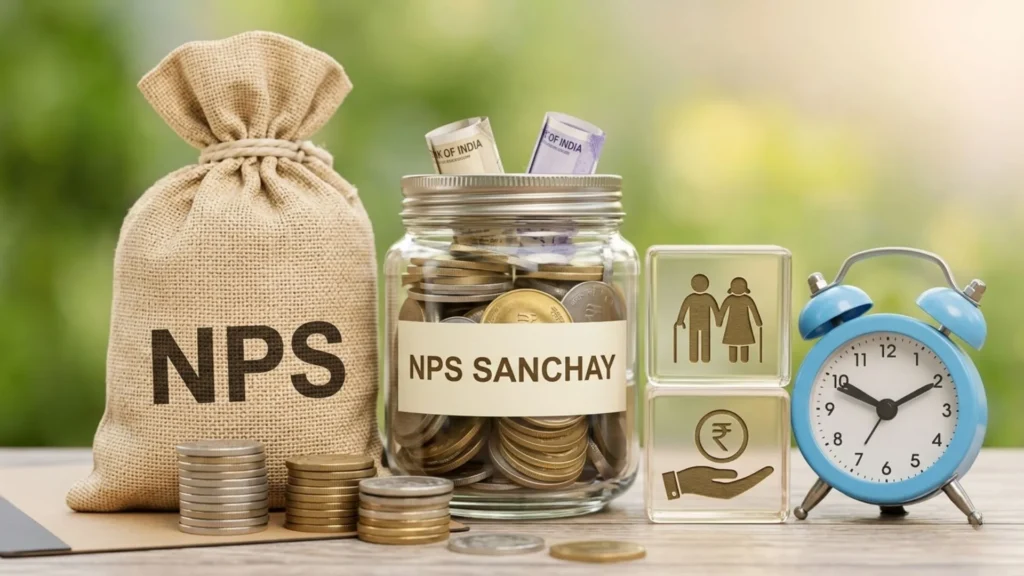
What is NPS ‘Sanchay’?
NPS Sanchay has been launched as a simplified version of the NPS established under the All Citizen Model and Multiple Scheme Framework (MSF). The main idea: To simplify pension investing for a lot more regular people who might have no evaluation of asset allocation, funds choice, or retirement planning nuances.
While the traditional investment products require users to make an effort to manage their investment portfolios, NPS Sanchay has a pre-determined structure that would make investment feasible. This is especially useful for those in the rural and semi-urban regions of India, where people might not have enough financial savants to guide them through.
The scheme is based on the existing guidelines of NPS that are framed by the PFRDA, which ensures transparency, regulation and credibility.
Who Can Apply for NPS Sanchay?
One of the strongest advantages of NPS Sanchay is its broad eligibility criteria. Any Indian citizen between the ages of 18 and 85 can open an account online or through authorized Points of Presence (PoPs), subject to KYC verification.
This wide age bracket makes the scheme highly inclusive. A young delivery executive starting work at 22 can invest for decades, while a 60-year-old self-employed trader can still join and begin structured retirement planning.
The simplified onboarding process is aligned with PFRDA’s recent push toward digital and easier NPS registration systems, including CKYC and bank-linked onboarding models.
Why NPS Sanchay Matters in 2026
India is witnessing rapid growth in the gig economy, freelance workforce, and self-employment sector. However, most workers in these categories lack provident fund benefits, employer-sponsored pensions, or long-term retirement savings plans.
This is where NPS Sanchay becomes crucial.
The scheme addresses three major financial challenges faced by informal workers:
- Lack of retirement planning
- Limited financial literacy
- Absence of professional investment advice
By automating investment allocation and reducing complexity, NPS Sanchay removes psychological barriers that often prevent low and middle-income individuals from investing.
Experts believe that simplified pension systems will become increasingly important as India’s population ages and traditional family-based retirement support structures weaken.
Key Features of NPS Sanchay
NPS Sanchay’s biggest attraction is its simplicity and usability.
The scheme is regulated under NPS which allows the investors to have exposure to the professionally managed pension funds and still enjoy long term wealth creation opportunities. Subscribers will also be able to change pension fund managers and adjust their holdings in light of the NPS rules.
Still another important consideration is the low costing. The charges as well as the contribution requirements are similar to the other NPS schemes like NPS All Citizen, NPS Vatsalya and NPS Lite. This will guarantee that individuals whose earnings are unpredictable can afford it too.
The investment approach is aligned with the existing rules & regulations laid by Government in the NPS sector where equity and debt exposure has been optimised in order to ensure the growth of an orderly retirement corpus over the years.
Withdrawal And Exit Rules explained.
Restrictions on liquidity and flexibility around withdrawals are some of the common concerns of pension schemes. Fortunately, the NPS Sanchay has the same withdrawal and exit rules as are used in the regular NPS.
This will enable the subscribers to avail partial withdrawals under the conditions provided without affecting the ongoing changes in the pension regime introduced under PFRDA. NPS Sanchay will automatically be affected by changes in NPS rules in the future.
Flexibility will already be enhanced as a result of recent changes to the NPS. Previously private subscribers were able to withdraw up to 60% of the corpus as a lump sum at their retirement, but the government increased it to 80%.
The increased flexibility is a welcome difference between the NPS Sanchay and traditional retirement products which tend to be inflexible when it comes to payment payouts.
How NPS Sanchay Can Build Long-Term Wealth
Retirement planning works best when investments are started early. Even small monthly contributions can grow substantially over time through compounding.
For example, if a 30-year-old gig worker contributes ₹3,000 monthly to NPS Sanchay and earns an average annual return of 10%, the retirement corpus at age 60 could exceed ₹68 lakh through disciplined investing over three decades.
This demonstrates the real power of long-term pension investing.
Additionally, India’s pension ecosystem is evolving rapidly under the Multiple Scheme Framework (MSF), which allows greater innovation and more customized pension products.
Why NPS Sanchay Stands Out From Other Retirement Plans
Many traditional retirement products sold in India come with high charges, complex structures, limited transparency, or lower flexibility.
In contrast, NPS Sanchay offers:
- Regulatory protection under PFRDA
- Lower cost structure
- Simplified investing process
- Flexibility in fund management
- Access to long-term market-linked returns
- Inclusion for informal workers
- Digital onboarding convenience
Unlike many insurance-linked savings products, NPS-based retirement investing focuses on disciplined wealth accumulation instead of complicated policy structures.
As India’s financial ecosystem becomes more digital and inclusive, schemes like NPS Sanchay could emerge as the preferred retirement planning option for millions of self-employed and informal workers.
Final Thoughts
The launch of NPS Sanchay marks a major milestone in India’s pension and financial inclusion journey. For millions of workers without formal retirement benefits, the scheme offers a practical, low-cost, and regulated pathway toward financial independence after retirement.
Its simplified structure, broader accessibility, and flexibility make it one of the most important retirement initiatives introduced in recent years.
For anyone working in the informal sector, relying solely on savings or family support after retirement may no longer be enough. Starting early with NPS Sanchay can create financial stability, peace of mind, and long-term wealth in a rapidly changing economy. Whether you are a freelancer, gig worker, shopkeeper, driver, farmer, or self-employed professional, this could be the pension solution that finally makes retirement planning simple and achievable.
Secure your future before it becomes expensive tomorrow — start your retirement journey with GoFinance and make every rupee work smarter for your life goals.