
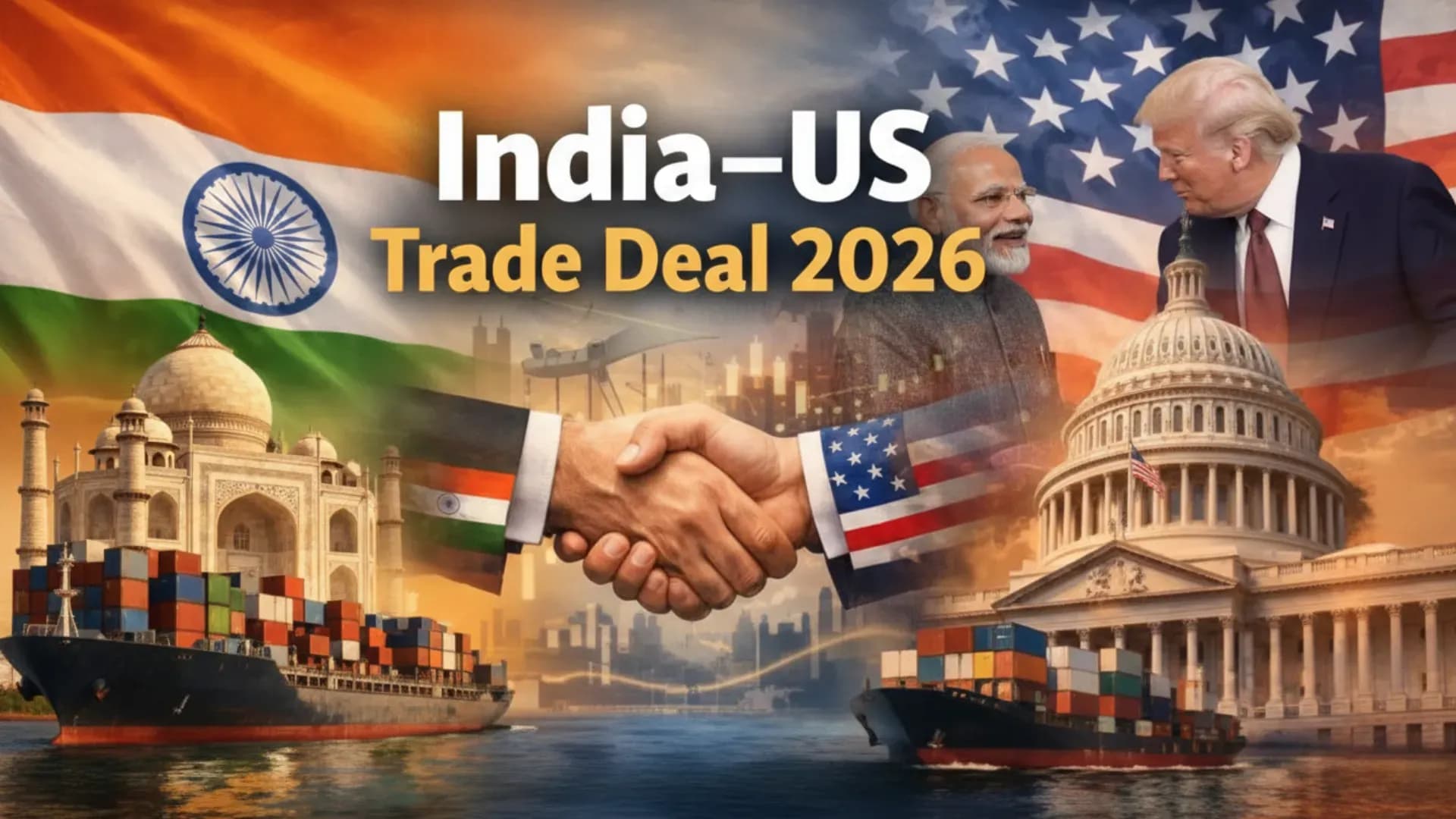
The India-US Trade Deal that was announced in February 2026 is a milestone in the Economic relationship between India and the United States. Following several months of trade friction, tariff increases and uncertainty, the deal is a good sign that cooperation and long-term economic engagement prevails again. The Finance Minister of India Nirmala Sitharaman said that the deal will sluice national interest and in tandem global trade realities, but secure sensitive domestic sectors.
This article describes the India-US trade deal in simple, comprehensible language, including the circumstances under which the deal was made, what the trade deal consists of and its implications to the Indian economy, business, consumers, and financial markets.
Why Did the India-US Trade Deal Have to Happen?
The prelude to this agreement was the straining relations between trade relations between India and the US. By 2025, the US had placed very high tariffs (as high as 50 percent) on a list of Indian exports. Such tariffs increased the price of Indian products in the US market which was detrimental to the exporters of Indian products in the US market in terms of engineering goods, gems and jewellery, handicrafts and textiles.
The US argued that these tariffs were required under trade imbalances and strategic interests such as the energy that India purchased in Russia. The tariffs, however, were considered unfair and harmful to the export-driven industries in India.
In spite of these difficulties, the Indian exports into the US were comparatively good and resilient. Nevertheless, the state of uncertainty over a long period posed business, employment and investment mobility threats. This necessitated the need to have a negotiated solution between the two.
What Are the Key Features of the Trade Deal?
1. Indian Goods Tariff Cuts by the US.
The US import tariffs on the Indian products are cut sharply, and it is the most significant part of the deal. The previously higher tariffs up to 50 percent have been brought down to approximately 18 percent in the form of a reciprocal tariff system.
This shift embraces instant competitiveness of the Indian products in the US market thus, the Indian exporters can effortlessly reclaim the lost orders and increase their market share.
2. India opens up its market more to the products of the US.
India, in its turn, has promised to reduce tariffs and soften trade restrictions on a set of products of the US. This features products in industries like:
- Energy (oil, gas, and the products).
- Defence equipment and aircraft.
- Industrial machinery
- Manufactured products of high value.
India also has embarked on buying more imports in the US in the next few years and the overall purchases will amount to hundreds of billions of dollars in the long run.
3. Sensitive Sectors Protection of India.
The effect it has on farmers and small producers is one of the most significant issues when trade negotiations take place. Finance minister, Nirmala Sitharaman stated that India has been able to safeguard the sensitive sectors, particularly the agriculture sector.
The dairy products, sugar, and some farm products still receive some protection. This guarantees Bridging sudden competition, which may have an impact on livelihoods and rural stability, on Indian farmers.
4. Strategic Energy and Foreign Policy View.
The merger is also an indication of larger strategic collaboration. India has accepted to have diversity in the imports of energy resources such as decreasing its reliance on Russian crude oil and increasing its imports with the US and other allies.
In as much as energy security is the priority of India, this is considered to be a move that puts the trade policy in line with broader diplomatic and geopolitical interests.
5. Some Tariffs Still Remain
It is also worth mentioning that tariffs have not been eliminated completely. The US national security regulations have kept its tariffs on steel, aluminium and copper. This implies that certain sectors in the Indian industries will still be challenged.
How Does This Deal Help Indian Businesses?
Boost for Exporters
The lower tariffs affect the Indian exporters directly. The respective industries that will gain most are:
- Textiles and garments
- Components and automotive engineering.
- Gems and jewellery
- Handicrafts and MSMEs
Low prices make Indian products competitive, which increases the level of exports and an improved profit margin.
Two facts: Jobs and Manufacturing Support.
Millions of workers are being employed by export-oriented industries particularly the labour intensive sectors. The deal helps save jobs by ensuring the reopening of the US market and contributes to the manufacturing centers in the states of Gujarat, Rajasthan, Tamil Nadu and Maharashtra.
Encouragement for New Investments
Clear and stable trade rules reduce uncertainty. As a result, both domestic and foreign investors are more willing to invest in factories, supply chains, and technology upgrades in India.
Impact on the Indian Economy
Improved Growth Outlook
Economists think that the trade agreement will boost greater economic growth. The booming exports, expanded foreign investments and better business confidence would enable India to continue growing its GDP by about 7 percent over the next few years.
Favorable Dynamic on the Stock and currency markets.
After the deal was announced:
- The Indian rupee became strong against the US dollar.
- Investor confidence increased leading to the increase of stock markets.
- Indian assets were attracting a fresh attention by foreign investors.
This indicates the perception of the market that the deal involves the minimization of economic risks in the long run.
How Does This Fit into India’s Global Trade Strategy?
Building the China +1 Opportunity.
It is widely being sought to have many global companies diversify supply chains as a way of reducing reliance on China. The India country is a better substitution destination since it offers an alternative manufacturing hub more appealing to the China+1 strategy, with a stronger access point to the US market.
Creating a Network of Enduring International Relationships.
The US trade agreement augments the general India attempt at signing trade agreements with the EU, UK and other high economies. Collectively, these agreements assist India in becoming even more adjoining within the world trade marketplaces.
Service to the National Interest Vs World Integration.
The agreement indicates that India is capable of interacting at the global level, without jeopardizing national interests as remarked upon by Finance Minister Sitharaman. Trade bargaining will enable India to enjoy the benefits of globalization without abandoning the economic freedom.
What Does This Mean for Ordinary Citizens?
For consumers, the deal may gradually lead to:
- Greater availability of high-quality imported goods
- Stable prices due to improved supply chains
- Stronger job creation through export growth
For students and professionals, the agreement signals growing opportunities in trade-linked sectors such as logistics, finance, manufacturing, and international business.
Conclusion: A Practical and Balanced Trade Agreement
The trade deal between India and the US of 2026 is not solely regarding tariffs but more on confidence, stability, and economic partnership over time. The agreement promotes growth, job security, and competitive advantage within India because it is capable of providing a balanced resolution to trade disputes and liberalizing the Indian markets.
As much as there are still hurdles, particularly in the areas where tariffs still prevail the deal has provided a good base on which the collaboration can be established in the future. It is a good move in the direction of a more predictable and growth-oriented trade environment of the importance of businesses, investors, and policymakers.
Boost your business with Go Finance-get quick, easy and flexible business loans to support your business. We offer all forms of finance and loan services which are usually easy to obtain and serve properly.