
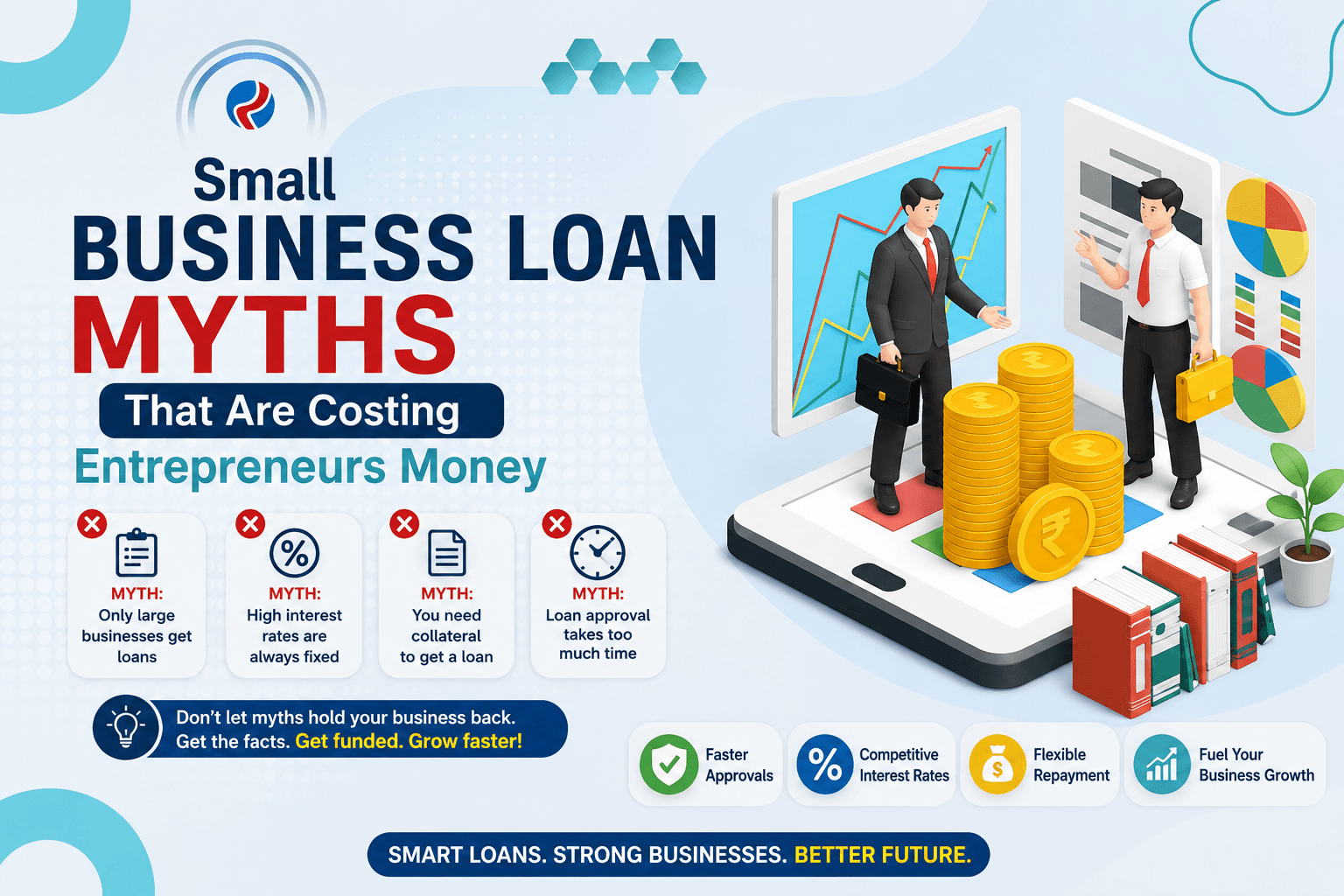
- 1.Myth 1: Every Small Business Loan Requires Collateral
- 2.Myth 2: You Need a Perfect Credit Score
- 3.Myth 3: The Lowest Interest Rate Is Always the Cheapest Loan
- 4.Myth 4: Taking the Maximum Loan Amount Is Better
- 5.Myth 5: Only Large Businesses Can Get Business Loans
- 6.Myth 6: Startups Cannot Get Business Financing
- 7.Myth 7: Business Loans Are Only for Expansion
- 8.Myth 8: Longer Tenure Always Means a Better Loan
- 9.Myth 9: Online Business Loans Are Not Reliable
- 10.Myth 10: You Should Apply to as Many Lenders as Possible
- 11.Myth 11: Getting Approved Means the Loan Is Affordable
- 12.How Entrepreneurs Can Make Better Borrowing Decisions
- 13.Conclusion
Every entrepreneur understands a small business loan is what’s required to secure inventory, create working capital, buy equipment, open a second office, and increase productivity. Still, too many approached loan applications armed with data collected from their friends, social feeds or perhaps another entrepreneur about how it “really works” with borrowing. This intelligence, unfortunately, can be inaccurate or no longer applicable. Knowing and dispelling the following common Small Business Loan myths could stop you from paying too much or from taking out loans that aren’t a good fit.
Myth 1: Every Small Business Loan Requires Collateral
This is one of the most common misconceptions among entrepreneurs.
Not every business loan requires property or another asset as security. Depending on the lender, loan product, borrower profile, and applicable government-backed credit guarantee, businesses may qualify for unsecured financing.
The Reserve Bank of India's MSME lending directions state that banks should not accept collateral security for certain loans up to ₹10 lakh extended to eligible micro and small enterprises. The rules and eligibility conditions still need to be checked for the specific loan and borrower.
Credit guarantee mechanisms such as CGTMSE can also support eligible MSE lending without conventional collateral.
What this means: Don't assume you need to own property before exploring business financing.
Myth 2: You Need a Perfect Credit Score
A strong credit history certainly helps, but there is no single credit score that guarantees approval from every lender.
When assessing a Small Business Loan application, lenders can consider several factors, including:
- Credit history
- Business turnover
- Cash flow
- Existing liabilities
- Profitability
- Business vintage
- Banking history
- Financial documentation
Your credit profile is important because it gives lenders an indication of your repayment behavior. However, it is only one part of the overall assessment.
A business with a good financial track record but an imperfect credit profile may still have financing options, depending on the lender's eligibility criteria.
Myth 3: The Lowest Interest Rate Is Always the Cheapest Loan
This mistake can be expensive.
A loan with a low advertised interest rate may still have processing fees, documentation charges, insurance costs, or other applicable expenses. The RBI has specifically emphasized that the total cost to the borrower should take into account interest and other charges associated with the loan.
Therefore, when comparing a Small Business Loan, don't look at the interest rate alone.
Instead, compare:
Cost Factor | What to Check |
Interest rate | How interest is calculated |
Processing fee | Percentage or fixed charge |
Documentation fee | Whether additional documentation costs apply |
Prepayment charges | Cost of closing the loan early |
Late payment charges | Penalties for missed or delayed EMIs |
Insurance | Whether it is required or optional |
Total repayment | Principal plus interest and applicable charges |
The right loan is not necessarily the one with the lowest advertised rate. It is the one with a cost and repayment structure that makes sense for your business.
Myth 4: Taking the Maximum Loan Amount Is Better
Getting access to a larger amount of money may sound attractive, but borrowing more than your business needs can increase financial pressure.
Suppose your business needs ₹5 lakh for inventory and equipment but you borrow ₹10 lakh simply because you qualify for it. The additional amount may increase your EMI and total interest without generating additional revenue.
Before applying, calculate:
- How much funding you actually need
- What the money will be used for
- Expected return from the investment
- Monthly repayment capacity
- Existing financial obligations
A Small Business Loan should solve a specific business requirement rather than create unnecessary debt.
Myth 5: Only Large Businesses Can Get Business Loans
Small businesses are an important part of India's formal credit ecosystem.
Under the RBI's MSME lending framework, micro, small, and medium enterprises are recognized categories for institutional lending. Retail and wholesale trade are also included as MSMEs for the limited purpose of priority sector lending, subject to applicable requirements.
Small businesses can include:
- Retail shops
- Traders
- Manufacturers
- Service providers
- Restaurants
- Professional businesses
- Small distributors
- Other eligible enterprises
Eligibility varies by lender, so being a small business does not automatically mean you cannot qualify.
Myth 6: Startups Cannot Get Business Financing
New businesses can face more difficulty because they have limited operating history and may not have extensive financial records. But that does not mean every startup is automatically excluded from financing.
Some lenders and government supported programmer have products designed for newer businesses and specific categories of entrepreneurs.
However, startups should be realistic about their funding requirements. A strong business plan, promoter profile, projected cash flows, available contribution, and clear use of funds can help demonstrate how the proposed financing will support the business.
Myth 7: Business Loans Are Only for Expansion
Expansion is certainly a common reason for borrowing, but it is not the only one.
Entrepreneurs may use business financing for legitimate business requirements such as:
- Purchasing raw materials
- Buying inventory
- Managing working capital
- Purchasing machinery
- Renovating business premises
- Opening a new outlet
- Purchasing commercial vehicles
- Supporting day-to-day operations
For example, SIDBI currently lists financing uses including machinery, business premises renovation, new outlets, commercial vehicles, raw materials, stocks, and other bona fide business activities.
The important point is to match the loan type and repayment structure with the actual requirement.
Myth 8: Longer Tenure Always Means a Better Loan
A longer repayment period can reduce the monthly EMI, which may make the loan easier to manage. However, spreading repayment over a longer period can also increase the total interest paid.
A shorter tenure may result in higher monthly repayments but can reduce the overall interest burden.
The right tenure depends on your business cash flow.
Before choosing one, ask:
Can my business comfortably pay this EMI every month without affecting working capital?
If the answer is yes, compare the total repayment under different tenures rather than selecting the longest option automatically.
Myth 9: Online Business Loans Are Not Reliable
Digital lending has changed the way businesses apply for financing. Applications can now be submitted online, while documents and financial information can be verified digitally.
The RBI has issued guidelines supporting online submission and tracking of MSME loan applications.
However, convenience should not mean ignoring due diligence.
Before accepting a digital loan, verify:
- Who the actual lender is
- Applicable interest rate
- Processing charges
- Repayment schedule
- Prepayment conditions
- Grievance redressal mechanism
- Complete loan documentation
Never choose a lender simply because the application process looks fast.
Myth 10: You Should Apply to as Many Lenders as Possible
Applying to multiple lenders may seem like a good way to increase your chances of getting an offer. However, indiscriminate applications can create unnecessary credit enquiries and make your borrowing profile appear more aggressive.
Instead, research lenders first.
Compare their:
- Eligibility requirements
- Loan amounts
- Interest rates
- Processing fees
- Repayment periods
- Collateral requirements
Then apply to lenders where your business profile is reasonably aligned with their criteria.
Myth 11: Getting Approved Means the Loan Is Affordable
Loan approval only tells you that the lender is willing to provide financing under its terms. It does not automatically mean the loan is financially suitable for your business.
Before accepting an offer, calculate the actual repayment obligation.
Consider your:
- Monthly revenue
- Operating expenses
- Existing EMIs
- Seasonal fluctuations
- Emergency reserves
- Expected business returns
Your objective should be to borrow an amount that your business can repay comfortably, not simply the maximum amount a lender offers.
How Entrepreneurs Can Make Better Borrowing Decisions
Instead of relying on loan myths, follow a simple process.
Start With the Purpose
Know exactly why you need the money and how it will contribute to the business.
Calculate the Requirement
Borrow enough to meet the objective without unnecessarily increasing your debt.
Compare the Complete Cost
Look beyond the headline interest rate and review every applicable charge.
Verify that your match the eligibility criteria
Do check the lender's criteria on credit history, turnover, business vintage, documentation and repayment ability.
Understand the terms stated in the loan agreement
Never go by verbal assurances only; ensure you understand everything stated on the paper before signing the loan.
Prepare to make payment ahead of time
Your business should at least handle the EMI payments during the lean periods as well.
Conclusion
A Business Loan has a lot to offer to entrepreneurs if chosen properly and used with clarity. However, many myths can lead to entrepreneurs over-borrowing money, being unaware of hidden costs or being ignorant of a loan type that would indeed be beneficial to their business.
The way forward is to know your actual cost of borrowing, your eligibility, and also compare different lenders, and most importantly, think of the impact on your business's cash flow. Go Finance empowers you to browse for business finance options that best suit your specific needs and financial status.
Whether it's funds for working capital, inventory, equipment, expansion, or any other business needs, compare the right loan options in the first place to borrow responsibly.
Frequently Asked Questions
1. 1) Does every business loan require security?
No. Depending on the type of lender and the scheme of loan, businesses may be able to secure a credit-guaranteed or unsecured business loan.
2. 2) If I have excellent credit, can I get a business loan?
No: Lenders also assess aspects like cash turnover, credit turnover, business Vintage, current loan, and bank statements.
3. 3) Should I select the business loan which offers a lower interest rate?
No: do not consider only interest rate, it's better to consider overall borrowing cost along with charges
4. 4) Can a new business avail of a business loan?
Yes, although eligibility can be more restrictive for businesses with limited operating history. Startup-focused and government-supported options may be available.
5. 5) How much can I borrow for business?
The business you wish to set up requires definite capital, Borrow no more than that, and try to keep the EMI affordable.
Go Finance
Go Finance made getting a loan very simple and fast! Their clear process and helpful team helped me get money for my dream without any problems. I highly recommend Go Finance to anyone who needs a quick and easy loan.