
- 1.Why do startups need capital funding?
- 2.1. Pradhan Mantri Mudra Yojana
- 3.2. PMEGP for New Entrepreneurs
- 4.3. Stand-Up India
- 5.4. Credit Guarantee Support for Startups
- 6.5. Startup India Seed Funding
- 7.6. Traditional Bank and NBFC Loans
- 8.How to Choose the Right Funding Option?
- 9.Check Your Repayment Capacity
- 10.Compare the Complete Cost of the Loan
- 11.Debt, Equity, or Grant: Which Is Better?
- 12.Documents You May Need
- 13.How can new firms acquire financing without traditional collateral?
- 14.Common mistakes to be avoided by Business Owners
- 15.Borrowing the maximum available amount
- 16.Final Thoughts
Starting a business takes much more than a sound idea; entrepreneurs invariably need funding to pay for equipment, create a stock of products or services, employ staff, design and develop a product, and cover operational costs, marketing and advertising costs, etc. Arranging this seed capital is arguably the biggest headache for many first-time entrepreneurs.
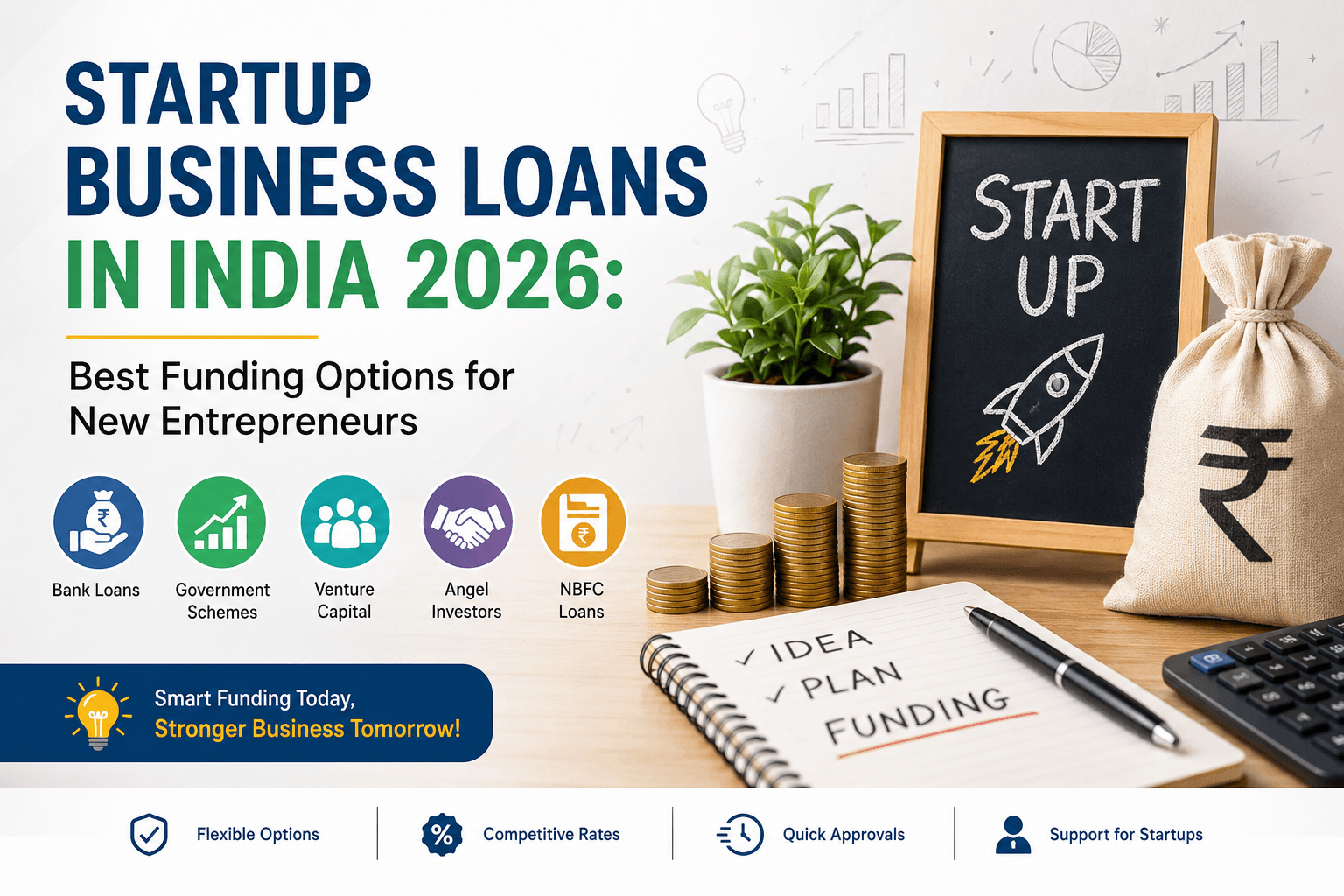
To their relief, there are a good number of business loan and funding opportunities in India to avail in 2026! Ranging from bank loans to government-sponsored loans, and from NBFCs to startup-focused loan schemes, there are various sources of raising capital.
The right source of financing will vary across individual startups depending on the type of business, scale of funding required, the entrepreneur's repayment capability, and eligibility.
Why do startups need capital funding?
Every business has different financial requirements. Some businesses need a large amount of capital before they begin operations, while others can start small and grow gradually.
A startup may need funds for:
- Product development
- Equipment and machinery
- Inventory and raw materials
- Office or shop setup
- Technology and software
- Employee salaries
- Marketing and advertising
- Rent and utilities
- Working capital
The challenge for new entrepreneurs is that they may not have a long business history or consistent revenue. This can make traditional financing more difficult. However, several startup business loans are designed to support small businesses and new entrepreneurs at different stages.
1. Pradhan Mantri Mudra Yojana
The Pradhan Mantri Mudra Yojana, commonly known as PMMY, is one of the popular funding options for micro and small businesses in India.
The scheme offers different loan categories based on the funding requirement. These include:
Shishu
Suitable for entrepreneurs with smaller funding requirements.
Kishor
Designed for businesses that require a higher amount of funding for growth or expansion.
Tarun
Suitable for businesses with larger financing requirements within the scheme's standard loan structure.
Eligible borrowers may also explore Tarun Plus, which offers higher funding limits for qualifying borrowers who meet the required conditions.
Mudra loans can be useful for entrepreneurs involved in manufacturing, trading, or service based businesses.
2. PMEGP for New Entrepreneurs
The Prime Minister's Employment Generation Programme, or PMEGP, is another important option for people planning to establish a new micro enterprise.
The programme is designed to encourage self employment and support eligible entrepreneurs through bank financed projects and subsidy assistance.
PMEGP can be suitable for entrepreneurs planning to start businesses in areas such as:
- Manufacturing
- Services
- Small scale production
- Local businesses
- Eligible trading activities
The funding structure, subsidy, and eligibility conditions can depend on factors such as the applicant category, project location, and type of business.
For entrepreneurs planning a new micro enterprise, PMEGP can be worth exploring before choosing a regular commercial loan.
3. Stand-Up India
Stand-Up India is designed to promote entrepreneurship among eligible women entrepreneurs and individuals from Scheduled Castes and Scheduled Tribes.
The scheme supports eligible greenfield enterprises in sectors such as:
- Manufacturing
- Services
- Trading
- Certain agriculture allied activities
Eligible entrepreneurs may access composite loans for starting a new business, subject to the applicable eligibility and lending conditions.
This option can be particularly useful for entrepreneurs who meet the scheme requirements and are planning to establish a new venture.
4. Credit Guarantee Support for Startups
One major challenge for new businesses is the lack of collateral.
Many entrepreneurs do not own property or other high value assets that can be offered as security for a business loan. Credit guarantee programmes can help address this challenge by providing support to eligible lending institutions.
These programmes may help lenders extend financing to eligible businesses without relying entirely on traditional collateral.
However, entrepreneurs should remember that collateral free financing does not mean guaranteed approval. The lender may still assess:
- Business viability
- Repayment capacity
- Credit profile
- Financial position
- Promoter experience
- Business plan
This is why preparing a strong application remains important.
5. Startup India Seed Funding
Not every startup is ready to take a traditional business loan.
An early stage startup that is still developing a product or testing its market may not have enough revenue to manage monthly loan repayments. In such cases, seed funding or other forms of startup financing may be more suitable.
Startup focused funding can support activities such as:
- Proof of concept
- Prototype development
- Product testing
- Market entry
- Commercialization
Depending on the funding programme and eligibility, startups may receive financial support through grants, debt instruments, or other funding structures.
6. Traditional Bank and NBFC Loans
Entrepreneurs can also explore startup business loans offered by banks and NBFCs.
These loans may be structured in different ways depending on the business requirement.
Common options include:
Term Loans
Suitable for planned expenses such as business expansion, equipment purchases, or long term investments.
Working Capital Loans
Designed to help businesses manage regular operational expenses such as inventory purchases, salaries, supplier payments, and other short-term requirements.
Equipment Financing
Useful for businesses that need machinery, tools, vehicles, or specialised equipment.
Business Credit Facilities
Some lenders offer flexible credit options that allow businesses to access funds based on their approved limit and requirements.
For a new business, the lender may evaluate the entrepreneur's personal financial profile, credit history, business experience, and proposed business model.
How to Choose the Right Funding Option?
Before applying for startup business loans, it is important to understand exactly how much money your business needs.
Calculate Your Actual Requirement
Prepare a detailed estimate of your expected expenses.
Business Expense | Examples |
Equipment | Machinery, tools, technology |
Inventory | Initial stock and raw materials |
Setup Costs | Rent, deposits, furniture |
Employees | Salaries and recruitment |
Marketing | Advertising and promotions |
Working Capital | Day-to-day expenses |
Avoid borrowing more money than necessary. A larger loan can result in higher EMIs and greater financial pressure.
At the same time, borrowing too little can leave your business without enough capital to complete its plans.
Check Your Repayment Capacity
This is one of the most important steps when considering startup business loans.
A new business may take time to generate stable revenue. Before taking a loan, calculate whether you can manage the monthly EMI during slower periods.
Consider:
- Expected monthly revenue
- Regular business expenses
- Existing EMIs
- Personal financial obligations
- Seasonal changes in sales
- Emergency expenses
Your repayment plan should be based on realistic numbers rather than overly optimistic future projections.
Compare the Complete Cost of the Loan
Many entrepreneurs focus only on the interest rate when comparing loans.
However, the actual cost can also include:
- Processing fees
- Documentation charges
- Insurance charges, where applicable
- Late payment fees
- Prepayment charges
- Foreclosure charges
- Other applicable costs
Always compare the complete loan terms before making a decision.
Debt, Equity, or Grant: Which Is Better?
Different funding methods suit different types of startups.
Funding Option | Suitable For | Key Consideration |
Business Loan | Businesses with repayment capacity | Regular EMI obligation |
Equity Funding | High growth startups | Ownership dilution |
Grant | Specific business activities | Limited eligibility |
Seed Funding | Early stage development | Programme requirements |
A business loan allows the entrepreneur to retain ownership of the company but requires regular repayment.
Equity funding does not involve traditional EMIs, but investors may receive ownership in the business.
Grants generally do not need to be repaid, but they are often available only for specific purposes and eligible applicants.
The best option depends on the stage and financial condition of your startup.
Documents You May Need
The documents required for startup business loans can vary depending on the lender and type of financing.
However, entrepreneurs may commonly need:
- PAN Card
- Aadhaar Card
- Business registration documents
- Udyam Registration, where applicable
- GST documents
- Bank statements
- Income Tax Returns, where available
- Business plan
- Project report
- Financial projections
- Business address proof
- Estimates of Equipment, where applicable
For a brand-new enterprise, there’s perhaps extra leverage to your small business plan, as it might explain concepts, sources, projections and a reimbursement path.
How can new firms acquire financing without traditional collateral?
Many government loan applications feature credit programs and loan assurance plans, which may enable creditworthy entrepreneurs' entry into financing options based upon a plan rather than on their property.
Nevertheless, a number of lending considerations stay applicable. They should consider the potential success of the enterprise, the credibility and the reimbursement capability of the entrepreneur. A personal credit rating in such circumstances additionally impacts the choice.
Common mistakes to be avoided by Business Owners
Borrowing the maximum available amount
No matter the amount of cash you are allowed to obtain doesn’t imply that it’s what it’s best to obtain. Take only the amount required for your business.
Ignoring Working Capital
Many entrepreneurs calculate the cost of setting up the business but forget about expenses such as salaries, rent, inventory, and utilities.
Choosing a Loan Only Based on Interest Rate
Always compare the complete cost, repayment tenure, and additional charges.
Depending Completely on Future Revenue
Sales projections can change. Prepare for slower periods and unexpected expenses.
Mixing Personal and Business Finances
Keeping business and personal finances separate can make it easier to manage cash flow and understand the actual financial performance of your startup.
Final Thoughts
Starting a business requires careful financial planning. The availability of startup business loans, government schemes, and other funding options gives new entrepreneurs several ways to arrange the capital needed to turn an idea into a functioning business.
Before applying for funding, calculate your exact requirement, prepare a realistic business plan, understand your repayment capacity, and compare different options carefully.
The best funding option is not always the one offering the highest amount. It is the one that gives your business enough capital to achieve its goals without creating an unsustainable financial burden.
Frequently Asked Questions
1. 1. Can a new entrepreneur get a startup business loan without business experience?
Yes, some lenders and government schemes support first time entrepreneurs, subject to eligibility requirements.
2. 2. Are startup business loans available without collateral?
Some schemes and lending options may offer collateral-free financing, depending on eligibility and lender policies.
3. 3. Which government scheme can help a new entrepreneur start a business?
PMMY, PMEGP, and Stand Up India are among the options entrepreneurs can explore.
4. 4. Can startup loan funds be used for working capital?
Yes, depending on the loan product, funds may be used for inventory and operational expenses.
5. 5. What should I prepare before applying for a startup business loan?
Prepare your business plan, financial estimates, required documents, and a realistic repayment strategy.
Go Finance
Go Finance made getting a loan very simple and fast! Their clear process and helpful team helped me get money for my dream without any problems. I highly recommend Go Finance to anyone who needs a quick and easy loan.