
- 1.What is a Traditional Business Loan?
- 2.What Are Startup Business Loans?
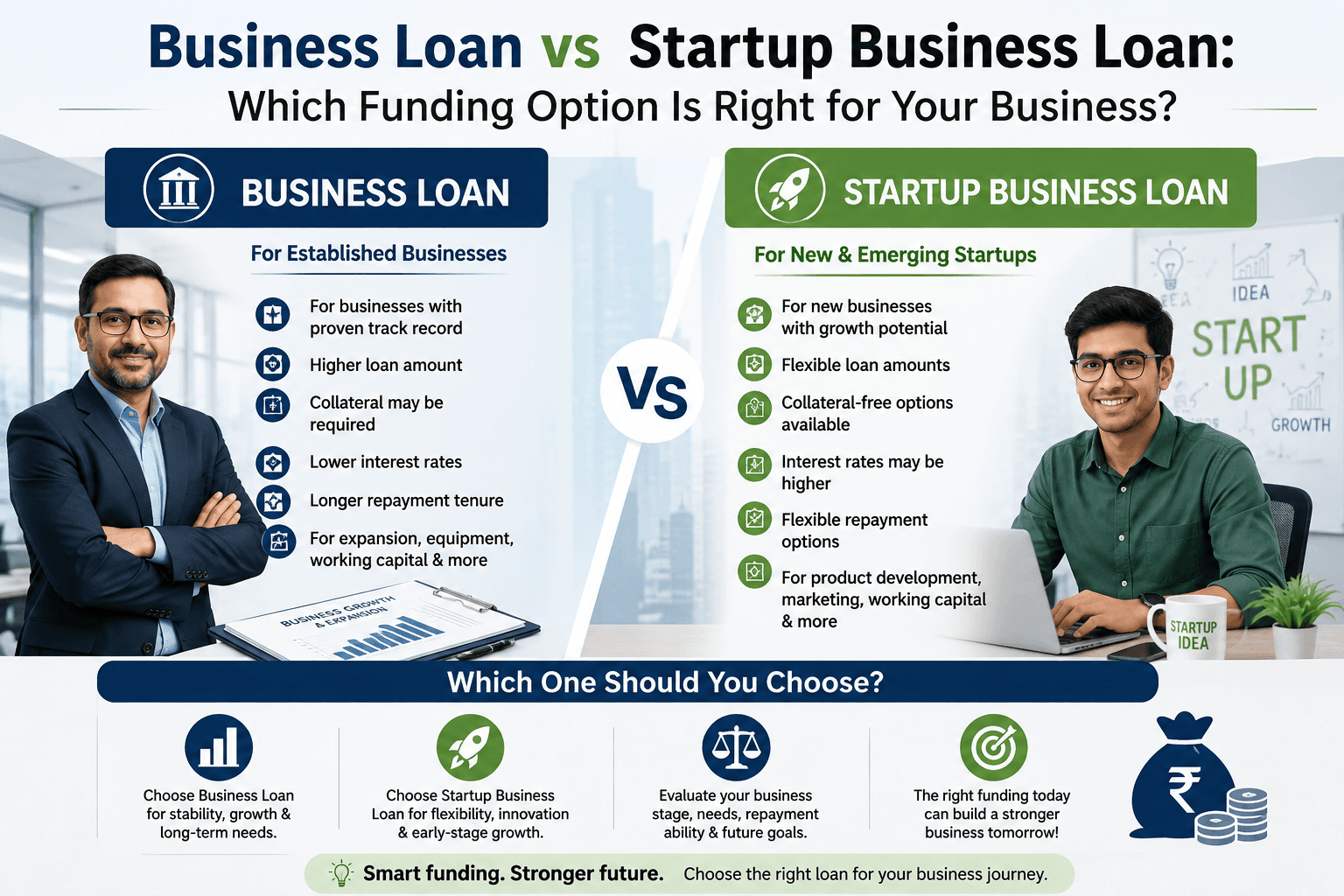
- 3.Business Loan vs Startup Business Loan: Key Differences
- 4.When Should You Choose a Traditional Business Loan?
- 5.When Should You Consider Startup Business Loans?
- 6.Eligibility: What Do Lenders Look At?
- 7.How Much Should You Borrow?
- 8.The Importance of Repayment Capacity
- 9.Other Funding Options for Startups
- 10.How to Choose Between the Two?
- 11.Common Mistakes to Avoid
- 12.Final Thoughts
Securing funding is a critical part of most startups - either to get up and running or to scale an existing one. However, the funding type and requirements of an emerging company often differ from those of an established one. That is why differentiating traditional business loans from startup business loans is vital.
While a traditional business loan generally applies to businesses with a track record, startup business loans could take into account issues related to new business owners or their projects.
The right type of loan also relies on the business you are working on, the amount required, your creditworthiness, as well as the business’s overall capability to repay.
What is a Traditional Business Loan?
A Traditional Business Loan or a business credit generally offers capital for a predefined sum.
Business loan funds can usually be utilized for:
- Business expansion
- Working capital
- Purchasing inventory
- Buying equipment or machinery
- Opening a new branch
- Managing operational expenses
- Technology upgrades
Traditional business loans are often easier to evaluate when the business already has a financial track record. Lenders may review factors such as business turnover, profitability, bank statements, repayment history, credit score, and business vintage before making a lending decision.
The better and more established the financial record, the easier it may be for the lender to assess repayment capacity.
What Are Startup Business Loans?
Startup business loans are funding options designed for new businesses, first-time entrepreneurs, and ventures with limited operating history.
A startup may not have years of financial statements, stable revenue, or a long business track record. Because of this, lenders and funding programmes may assess other factors, including:
- The founder's credit profile
- Business plan
- Industry experience
- Projected cash flow
- Business model
- Funding requirement
- Promoter contribution
- Repayment strategy
Startup financing can come through traditional lenders, NBFCs, government schemes, credit guarantee programmes, or startup-focused funding initiatives.
Business Loan vs Startup Business Loan: Key Differences
Factor | Traditional Business Loan | Startup Business Loan |
Suitable For | Existing businesses | New businesses and entrepreneurs |
Business History | Usually preferred | Limited history may be accepted |
Revenue Record | Often important | Projections may carry more importance |
Eligibility | Based on the business and borrower profile | May consider the founder and business potential |
Documentation | Financial records and business documents | Business plan and project details may be important |
Repayment | Regular EMI or agreed repayment structure | Depends on the funding product |
Funding Purpose | Growth, expansion, inventory, and operations | Setup, product development, equipment, and early operations |
Risk Assessment | Based largely on existing performance | Based on business potential and borrower profile |
The exact terms will always depend on the lender or funding scheme.
When Should You Choose a Traditional Business Loan?
A traditional business loan may be more suitable if your business is already operating and generating regular income.
For example, you may consider this option if you need funds to:
Expand Your Business
An established business may need capital to open another location, increase production capacity, or enter a new market.
Purchase Equipment
Machinery and equipment can require significant investment. A business loan may help spread the cost over a structured repayment period.
Manage Working Capital
Businesses often need additional funds to manage inventory purchases, supplier payments, salaries, and other operational expenses.
Take Advantage of Growth Opportunities
If your business receives a large order or identifies a new opportunity, additional financing may help you act without disrupting regular cash flow.
In these situations, an existing financial history can help demonstrate your ability to manage repayments.
When Should You Consider Startup Business Loans?
Startup business loans may be more relevant when your business is new and does not yet have an established financial track record.
You may consider startup-focused financing if you need capital for:
- Launching a new business
- Purchasing initial equipment
- Setting up a shop or office
- Buying initial inventory
- Developing a product
- Building technology
- Hiring an initial team
- Managing early operational costs
The challenge for new entrepreneurs is that revenue may be uncertain during the initial stage. This makes it important to borrow carefully and choose a repayment structure that your business can realistically manage.
Eligibility: What Do Lenders Look At?
The eligibility criteria can be different for an established business and a startup.
For an Existing Business
A lender may consider:
- Business turnover
- Profitability
- Business vintage
- Bank statements
- GST records
- Income Tax Returns
- Credit score
- Existing loan obligations
- Cash flow
For a Startup
The assessment may also include:
- Founder or promoter's credit history
- Business plan
- Market opportunity
- Industry experience
- Projected revenue
- Proposed use of funds
- Personal financial contribution
- Overall repayment capacity
A strong business idea alone may not be enough to secure funding. The lender will still want to understand how the borrowed money will be used and how it is likely to be repaid.
How Much Should You Borrow?
Whether you choose a traditional business loan or a startup business loans, borrowing the right amount is more important than borrowing the maximum amount available.
Prepare a detailed estimate of your funding requirement.
Expense | Examples |
Setup Costs | Rent, deposits, furniture |
Equipment | Machinery, tools, technology |
Inventory | Stock and raw materials |
Employees | Salaries and recruitment |
Marketing | Advertising and promotions |
Working Capital | Day-to-day business expenses |
This exercise helps you understand the actual amount required.
Borrowing too little can leave your business underfunded. Borrowing too much can increase your EMI and create unnecessary financial pressure.
The Importance of Repayment Capacity
One of the biggest differences between an established business and a startup is the predictability of cash flow.
An established business may have previous sales records and a better understanding of seasonal fluctuations. A startup may still be testing its market and building its customer base.
Before taking any loan, calculate:
- Expected monthly revenue
- Fixed operating expenses
- Existing financial obligations
- Proposed EMI
- Emergency reserves
- Seasonal changes in demand
Do not base your repayment decision entirely on optimistic future projections.
A loan should support business growth, not create a repayment burden that affects daily operations.
Other Funding Options for Startups
Not every new business needs to rely only on a conventional loan.
Depending on eligibility and the type of venture, entrepreneurs may explore:
Government-Supported Schemes
Certain schemes are designed to support micro enterprises, self-employment, women entrepreneurs, and other eligible business categories.
Credit Guarantee Support
Some programmes help lenders provide financing to eligible businesses without relying entirely on traditional collateral.
Seed Funding
Early-stage businesses working on product development or market testing may explore seed funding options.
Equity Funding
High-growth startups may raise capital from angel investors or venture capital investors. Unlike a traditional loan, equity funding generally involves giving investors a share in the business.
The right funding method depends on the stage and financial requirements of the business.
How to Choose Between the Two?
Before selecting a funding option, ask yourself the following questions:
- Is my business already operational?
- Do I have a stable revenue history?
- How much funding do I actually need?
- What will I use the funds for?
- Can I comfortably manage the monthly repayment?
- Do I have the financial documents required by lenders?
- Is a loan the right option, or should I explore other startup funding methods?
If your business already has stable operations and predictable cash flow, a traditional business loan may be a practical option.
If you are launching a new venture and have limited business history, startup business loans or startup-focused funding programmes may be more suitable.
Common Mistakes to Avoid
Borrowing Without a Clear Purpose
Every rupee borrowed should have a defined use within the business.
Taking the Maximum Amount Available
Your loan eligibility should not determine how much you borrow. Focus on your actual requirement.
Ignoring Additional Charges
Consider processing fees, late payment charges, prepayment conditions, and other costs.
Depending Completely on Future Revenue
Business growth can take longer than expected. Plan repayments based on realistic financial estimates.
Choosing Funding Without Comparing Options
Compare Lenders & Funding Models Before Committing
Final Thoughts
There isn't one right answer when deciding between a business loan and a startup business loan. The best option will be determined by the state your business is in.
A business loan might be more beneficial for an established company with consistent revenue, historical financial statements and the means to meet repayments. A startup business loan is specifically designed for beginners, may be more advantageous for new entrepreneurs whose limited operational history is less impactful to lenders.
When deciding, work out your realistic need, draft a realistic business plan, determine the full cost of debt, and analyze your repayment capabilities. Getting the right business financing should provide it with a vital boost to its operational health without becoming a burden for the foreseeable future.
Frequently Asked Questions
1. 1. Can a new business apply for a regular business loan?
Yes, but eligibility may depend on the lender's requirements, business model, founder profile, and financial documentation.
2. 2. Are startup business loans only for technology companies?
No. New businesses in manufacturing, services, retail, trading, and other sectors may also explore startup-focused funding.
3. 3. Do startup loans require collateral?
Not always. Some lenders and eligible funding schemes may offer collateral-free financing.
4. 4. What is more difficult to get, a startup loan or a business loan?
Startup financing can be more challenging because new businesses often have limited revenue and financial history.
5. 5. Should I choose equity funding instead of a startup business loan?
It depends on your business stage, cash flow, growth plans, and willingness to take on loan repayments or share ownership.
Go Finance
Go Finance made getting a loan very simple and fast! Their clear process and helpful team helped me get money for my dream without any problems. I highly recommend Go Finance to anyone who needs a quick and easy loan.